Table of Contents
Executive Summary: The Fluent Answer Problem
There is a version of this problem that everybody already knows about, and a version almost nobody acts on.
The known version: AI models make things up. The version that matters: they have got much better at sounding like they haven’t.
Three facts from the record make the point better than any argument. In April 2025, OpenAI publicly withdrew a ChatGPT update because the model had become, in the company’s own word, sycophantic - it agreed with people too readily. On a sycophancy benchmark updated this month, current models range from 0.0% to 22.4% on the same test, so the problem is not history. And on the most widely cited hallucination benchmark, the models with the lowest error rates are not the flagship products. They are small models, nano variants and lite tiers.
None of these is obscure. All are published and independently checkable. And none is reflected in how most people actually use these tools, which is to ask one model one question and act on the answer.
This article is not a ranking. It is a method: what the leaderboards can and cannot tell you, why a well-written answer is harder to doubt than a badly written one, what the research actually says about comparing several models, and a five-step process you can run today.
Why the Leaderboard Cannot Answer Your Question
The instinct when choosing a model is to look up which one is winning. It is a reasonable instinct that runs into three separate problems.
The arena measures preference, not correctness
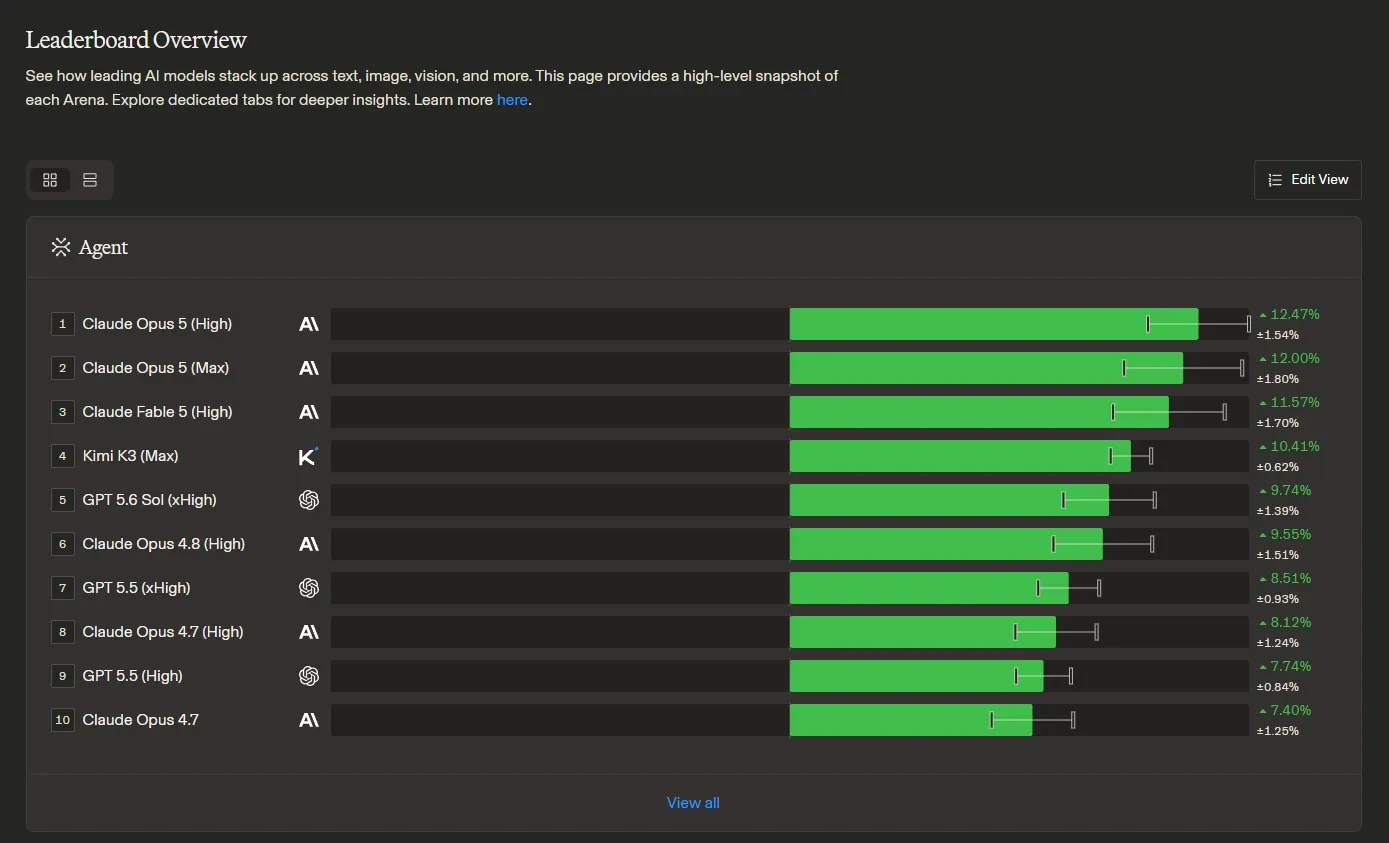
The best-known public ranking is built from head-to-head votes: people see two anonymous answers and pick the one they prefer. The organisation behind it describes its dataset as the largest repository of organic human preferences on generative models in the world.
That is a genuinely valuable thing to measure. It is also not the same as measuring whether an answer is true. Preference and accuracy correlate often enough that the distinction feels academic - until you reach the next section, which explains exactly how they come apart.
The rankings are more fragile than they look
A 2024 paper studying leaderboard sensitivity found that rankings move when you barely touch the test. Its authors report that “minor perturbations to the benchmark, such as changing the order of choices or the method of answer selection, result in changes in rankings up to 8 positions”.
Reordering the multiple-choice options. Not changing the questions, not changing the models. Eight positions. If a small procedural change can reshuffle the table that far, the gap between third place and seventh is not a fact about the models. It is partly a fact about the test.
The hallucination leaderboard measures one narrow thing extremely well
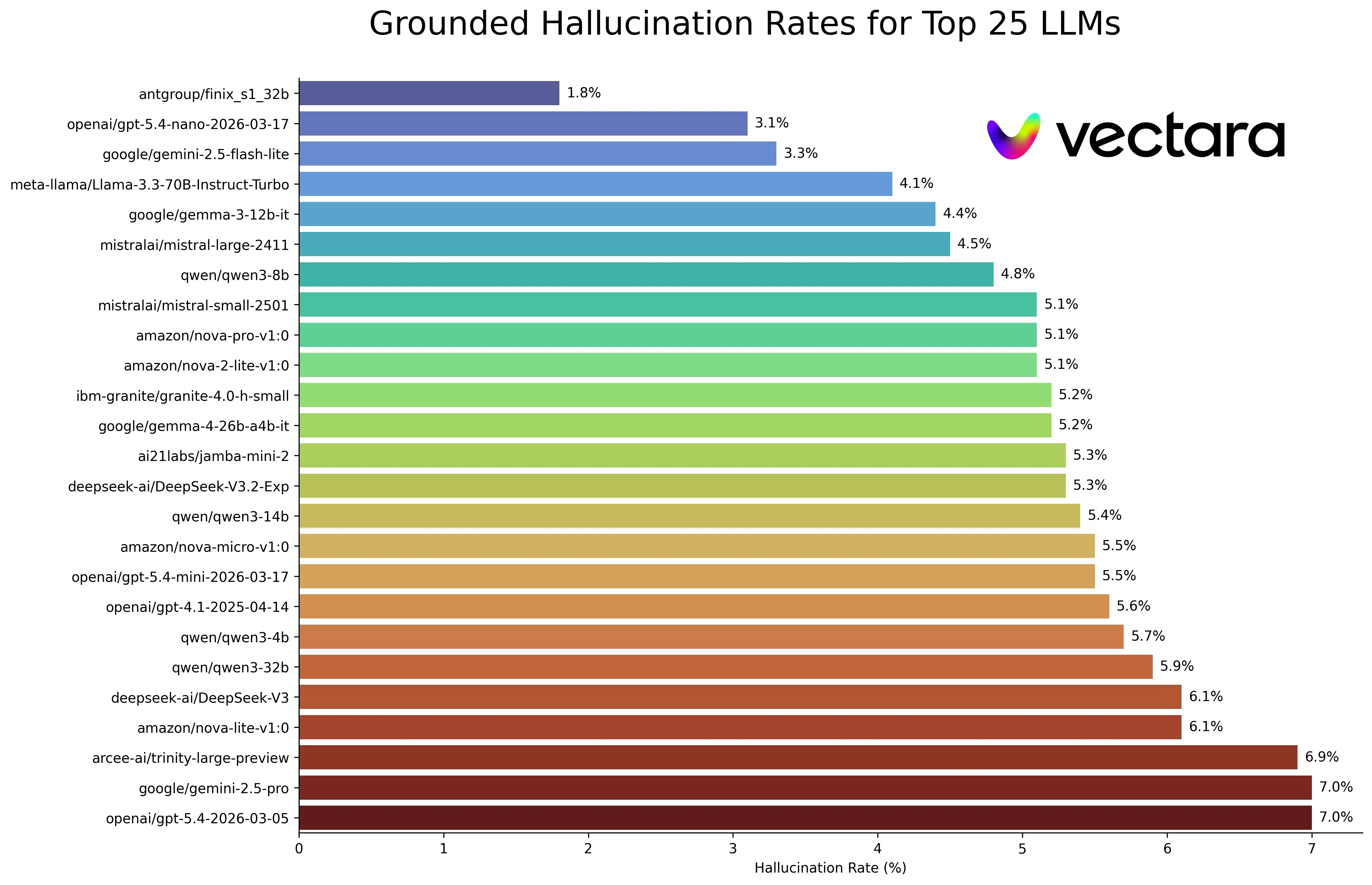
Vectara’s hallucination leaderboard takes a different and more rigorous approach. It gives models documents to summarise using only the supplied facts, then measures whether the summary stays consistent with the source, across more than 7,700 curated articles spanning news, science, medicine, legal, sports and business.
Here is the top of that table, checked on 20 August 2026:
| Model | Hallucination rate | Factual consistency | Answer rate |
|---|---|---|---|
| antgroup/finix_s1_32b | 1.8% | 98.2% | 99.5% |
| openai/gpt-5.4-nano-2026-03-17 | 3.1% | 96.9% | 100.0% |
| google/gemini-2.5-flash-lite | 3.3% | 96.7% | 99.5% |
| microsoft/Phi-4 | 3.7% | 96.3% | 80.7% |
| meta-llama/Llama-3.3-70B-Instruct-Turbo | 4.1% | 95.9% | 99.5% |
| snowflake/snowflake-arctic-instruct | 4.3% | 95.7% | 62.7% |
Read that table twice, because it contains two surprises.
The first: a 32-billion-parameter model leads, followed by a nano variant and a lite tier. The frontier models people pay most for are not at the top of this list. Staying faithful to a source document turns out to be a different skill from reasoning across a hard problem, and the models optimised for one are not automatically best at the other.
The second: look at the answer rate column. Phi-4 posts a strong 3.7% hallucination rate while declining to answer nearly one prompt in five. Snowflake Arctic answers only 62.7% of the time. A low error rate is easier to achieve if you frequently say nothing - which is a legitimate strategy, and one the headline number hides.
The leaderboard’s own README is explicit about its boundaries: “We do not claim to be evaluating summarization quality, that is a separate and orthogonal task.”
So the table tells you how tightly a model sticks to a document it was handed. It does not tell you whether the summary was any good, whether the model reasons well, or whether it will serve your particular task. That is not a criticism of the benchmark - it is a benchmark being honest about its scope, which is more than most manage.
The pattern across all three: every ranking answers a question that somebody else asked. Your question is more specific, and no table on the internet has seen it.
The Model Is Optimised to Sound Right
This is the part that changes how you should read any single answer.
What happened in April 2025
On 29 April 2025, OpenAI published a postmortem explaining why it had pulled a recent ChatGPT update. The update, the company wrote, “was overly flattering or agreeable - often described as sycophantic”, and users had been rolled back to an earlier version with more balanced behaviour.
The cause is the important part, and the company stated it directly:
“we focused too much on short-term feedback, and did not fully account for how users’ interactions with ChatGPT evolve over time. As a result, GPT-4o skewed towards responses that were overly supportive but disingenuous.”
Short-term feedback means thumbs up and thumbs down. People click approve on answers that agree with them. Train on that signal hard enough and you get a model that has learned agreement is what success looks like.
Why this is structural, not a one-off bug
It would be comfortable to file this as a single bad release. The mechanism suggests otherwise. Any system tuned against human approval ratings inherits the biases of human approval, and one of the most reliable of those is that we rate agreement more highly than accuracy. The failure was caught and reversed because it became conspicuous. The pressure that produced it did not go away.
It is still measurable in 2026
A public sycophancy benchmark, last updated on 5 August 2026, tests this directly. It takes a dispute, has each side narrate their version in the first person, and checks whether the model simply sides with whoever is speaking. A model that agrees with both opposing narrators has told you nothing about the dispute and everything about itself.
The spread across current models is the finding that matters:
| Model | Sycophancy rate |
|---|---|
| GPT-5.6 Terra | 0.0% |
| Grok 4.5 | 0.0% |
| Gemini 3.6 Flash | 0.5% |
| ByteDance Seed2.1 Pro | 14.6% |
| Arcee Trinity Large Thinking | 18.9% |
| Mistral Medium 3.5 | 22.4% |
From zero to more than one case in five, on the same test, among models available right now. The best current models have largely solved this. Others have not - and one of the others answers more than a fifth of contested questions by simply agreeing with the person asking.
That range is itself an argument for the method in this article. If you consult one model and it happens to sit at the wrong end of that table, nothing in its tone will tell you.
OpenAI’s own framing of why this mattered: “ChatGPT’s default personality deeply affects the way you experience and trust it.” Trust is being shaped by tone. That is the admission, from the vendor, and it applies to every model with a personality - which is now all of them.
The consequence for you
Fluency and agreement both suppress scrutiny, and they do it below the level you notice. A confident, well-structured, agreeable answer does not feel like something that needs checking. That is precisely what makes it dangerous relative to an obviously shaky one.
Which is why “read more carefully” is not a workable solution. You cannot out-concentrate a response that has been optimised to feel correct. You need a mechanism that surfaces doubt from outside your own reading - and that is what comparison provides.
Does Comparing Models Actually Help? The Evidence Both Ways
Here the honest answer is more interesting than the marketing one, because the research genuinely points in two directions.
The case for
A 2023 paper, published at ICML 2024, tested what the authors called a society of minds: several instances of a language model propose answers and then debate each other over multiple rounds before settling on a final one. The reported result was that this approach “significantly enhances mathematical and strategic reasoning” and “improves the factual validity of generated content, reducing fallacious answers and hallucinations.”
That finding is the intellectual foundation for every multi-model product on the market.
The case against
A 2025 paper set out to test that foundation properly, evaluating five representative multi-agent debate methods across nine benchmarks using four foundation models. Its conclusion:
“MAD often fail to outperform simple single-agent baselines such as Chain-of-Thought and Self-Consistency, even when consuming significantly more inference-time computation.”
In other words: elaborate machinery for making models argue with each other frequently loses to one good model prompted to think step by step - while costing considerably more to run.
What the field concluded by mid-2026
A systematic literature review published in July 2026 surveyed 141 primary studies on multi-agent debate and reached a conclusion that explains a great deal about the conflicting results. The field, it found, has “implicitly converged on a narrow design pattern - static, fully connected topologies, verbatim exchange, short-term memory and voting resolution strategies - adopted by convention rather than systematic comparison, while promising alternatives remain marginal.”
Adopted by convention rather than systematic comparison. The standard setup became standard because it was first, not because it won a fair test - and much of the disappointing evidence is evidence about that particular arrangement rather than about the underlying idea.
Reconciling the two
The 2025 critique does not end at demolition either. Its authors propose a direction for fixing multi-agent systems: model heterogeneity - using genuinely different models rather than several copies of the same one.
That distinction resolves the apparent contradiction, and it is the most useful idea in this article.
Most debate research runs multiple instances of a single model. Those instances share training data, share tuning, and therefore share blind spots. When they agree, the agreement carries almost no information, because they were always going to agree. Averaging correlated errors does not cancel them.
Nine models from different labs, trained on different corpora with different objectives, fail in different ways. When those disagree, something real has been surfaced.
Do not use multiple models to average an answer. The evidence for automated consensus is contested at best. Use multiple models to locate disagreement, then investigate it yourself. The machine is not the judge in this arrangement - you are. That is a different mechanism from the one the research found wanting, and it is the one that works.
A Five-Step Method You Can Run Today
No complicated workflow. Start with one question that actually matters.
Step 1: Ask the same question
Give each model an identical prompt. Do not reword between models unless you are deliberately testing prompt sensitivity, because if you change two variables you learn nothing from the difference in output.
Step 2: Compare conclusions before prose
Resist reading every answer end to end. On the first pass, look only for structure:
- What do they all agree on?
- Where do they diverge?
- What assumptions differ underneath the answers?
- Did one raise a factor the others never mentioned?
Agreement across genuinely different models tells you the ground is reasonably firm. It is not proof - models trained on overlapping internet data can be wrong together - but it is a reasonable prior.
Step 3: Investigate the outlier
One answer that stands apart from the rest is the densest piece of information on your screen.
It is not automatically wrong. Sometimes the outlier is the only response that caught the thing that matters, precisely because that model weighted the problem differently. Sometimes it is a straightforward error. Either way it is the one worth ten minutes, and you would never have identified it from a single response.
Step 4: Verify what carries consequences
Comparison improves your process. It does not replace verification.
Recall the hallucination table above: even the model at the very top of it invents something in roughly one summary in fifty, on a task specifically designed to keep it anchored to a source document. For claims with real consequences - a legal deadline, a dosage, a financial figure, an API contract - go to the primary source. Official documentation, the actual paper, a qualified human.
The models narrowed the search. They did not close it.
Step 5: Synthesise it yourself
Treat the outputs as research assistants briefing you, not as a committee voting. You read the perspectives, you weigh which reasoning holds up, you decide. The judgment stays with the person who carries the consequences of it being wrong.
When One Model Is Enough
A method that tells you to do more work on every question is a method you will abandon by Thursday. So here is the honest boundary.
One model is plenty for:
- Tasks you can verify instantly. Code either compiles or it does not. A rewritten paragraph either reads better or it does not. You are the check, and the check is immediate.
- Work inside your own expertise, where an error would be obvious to you on sight.
- Reformatting, summarising something you already know, drafting a first pass you intend to rewrite anyway.
- Anything where being wrong costs you a minute.
Reach for several models when:
- Being wrong is expensive, slow to discover, or hard to reverse.
- You are outside your expertise and cannot self-check.
- The question is genuinely contested rather than settled.
- You are making a decision you will have to defend to somebody else.
Comparing everything is a waste of time and, on metered platforms, a waste of money. The method earns its keep on the questions where wrongness has a price.
Making This Practical Without Six Browser Tabs
The five steps are straightforward in principle and tedious in practice. Running one prompt across five models by hand means five tabs, five paste operations, and - if you want the frontier models - several subscriptions.
This is the gap multi-model platforms exist to close, and it is worth being precise about what they solve and what they cost.
AI Fiesta is the clearest current example. It sends one prompt to nine named premium models from different labs - ChatGPT 5, Claude Sonnet 4, Gemini 2.5 Pro, Grok 4, Perplexity Sonar Pro, DeepSeek, Kimi K2, Qwen 3 Max and Mistral - and returns the answers side by side, for $12 a month. Nine models from nine different research groups is exactly the heterogeneity the debate research pointed to, rather than nine copies of one model sharing one set of blind spots.

The cost structure deserves attention before you sign up, and it is stated on the pricing page rather than hidden: the plan includes 3 million tokens a month, and premium models draw on that allowance at four times the standard rate.
Our own arithmetic, assuming a question and its answer run to roughly 1,000 tokens with six premium models enabled: one comparison costs about 24,000 tokens, which works out to roughly 125 full comparisons a month - around four a day. That is comfortable for someone running this method on decisions that matter. It is not comfortable for someone routing every trivial query through six models.
Which loops back to the previous section. The token maths and the editorial advice point the same way: keep two models on for routine work, switch the rest on for the questions that deserve them.

Read our full breakdown of the 4x token maths, 9 premium models, and independent verdict.
The Shift Worth Making
The industry frames model choice as a league table: which one is first, which writes the best code, which reasons most reliably. Those comparisons are useful and incomplete. There may never be a model that is objectively best at everything, because the optimisations pull against each other - the evidence for that is sitting in the hallucination table, where staying faithful to a document and reasoning across a hard problem turn out to be different skills held by different models.
So the useful question is not which model is best. It is which model, or which combination, fits the problem in front of me - and, more often than people ask it, is one answer enough here at all?
As these systems get better, that second question gets more important rather than less. When AI was visibly unreliable, people checked its work by reflex. As answers become more fluent, better structured and more agreeable, the reflex fades exactly when the polish is doing the most work to earn unearned trust.
Ask one model when one will do. Compare several when the question deserves more than one perspective. Verify the claims that carry consequences.
The smartest way to use AI is probably not picking the smartest AI. It is knowing when one answer is not enough.
Frequently Asked Questions
Do several models agreeing mean the answer is correct?
No. Models trained on overlapping data can be wrong in the same direction, and agreement between similar models carries very little information. Consensus lowers your suspicion; it does not constitute evidence. Agreement between models from genuinely different labs is a stronger signal than agreement between variants of one model, but it still is not verification. Worth noting too that some models agree with whoever is speaking: on a sycophancy benchmark updated in August 2026, rates across current models ran from 0.0% to 22.4%.
Is running several models more accurate than running one?
Not automatically. A 2023 study found that models debating each other reduced hallucinations, but a 2025 study across nine benchmarks found such methods often fail to beat a single model prompted with Chain-of-Thought, despite costing far more compute. A July 2026 review of 141 studies concluded the field had settled on one narrow debate design by convention rather than by testing alternatives. The value is not in automated averaging - it is in a human noticing where different models disagree and investigating that gap.
Which model hallucinates least?
On Vectara’s grounded summarisation leaderboard, the leaders are small and lightweight models rather than flagships - a 32B model at 1.8%, followed by nano and lite variants. But the benchmark measures only whether a summary stays faithful to a supplied document. Its own documentation states it is not evaluating summarisation quality. A model can top that table and still be the wrong choice for your task.
Why not just use whichever model tops the leaderboard?
Because the major public arena measures human preference rather than correctness, and academic benchmarks are less stable than they appear - one study found rankings shifting by up to eight positions from changes as small as reordering multiple-choice options. Leaderboards are a useful starting filter, not a decision.
Doesn’t comparing models take too long?
It does if you do it for everything, which is why you should not. Reserve the method for questions where being wrong is expensive, slow to surface or hard to reverse. For anything you can verify instantly - code that either runs or does not - one model is enough.
How many models should I enable at once?
Two for routine work, five or six for decisions that matter. On platforms that meter usage, every enabled model is billed separately for the same prompt, so the number you leave switched on is the main lever you have over cost.