

The Bottom Line
Greptile is ranked #5 in our AI Coding & Development category. Graph-indexed AI code review with parallel agents and full-codebase context. We rate it 4.8/5.
Best for
Teams with large, interconnected codebases where cross-file impact is the defect class that hurts; organisations that need self-hosting, air-gapped deployment or their own language models inside their perimeter.
Considerations
Teams on Bitbucket or Azure DevOps, where it is not an option at all; teams with low tolerance for review noise who will not invest in tuning.
Executive Summary & Independent Verdict
Greptile describes itself as “AI agents that review and test pull requests with full context of the codebase”, and the phrase that matters in that sentence is full context.
Most automated reviewers read a diff. Greptile reads the repository first. It indexes your codebase by building “a graph of your repo - files, functions, and dependencies”, then deploys a swarm of parallel agents that “review changes, assess their impact beyond the diff, and flag issues.” Over time it reads engineer comments on its own reviews to learn your coding standards.
That architecture produces a specific and well-documented trade-off, and an honest review has to lead with it: Greptile is repeatedly reported as catching more issues than competitors in a single pass, while also producing more false positives. Depth and noise come from the same design decision.
We place Greptile at #5 in AI Coding & Development. It is the most credible direct alternative to CodeRabbit we have reviewed, it is stronger than CodeRabbit on self-hosting flexibility, and it is weaker on platform coverage and on the default data-handling posture.
The Graph Index: What Makes It Different
Reading the repository, not the diff
The distinction that defines this product is between analysing changed lines and analysing changed lines in context.
Greptile constructs a graph index of the entire repository, mapping files, functions, classes and dependencies. When a pull request modifies a function, the reviewer can traverse that graph to find every caller, every type that depends on the return shape, and every module that would be affected.
A reviewer that reads only the diff sees a two-line change to a utility function and has no way to know that eleven call sites make assumptions the change invalidates. That class of defect - the one where the modified code is correct and the consequences are not - is precisely what human reviewers catch when they know the codebase and miss when they do not.
The agent swarm
Rather than a single pass, Greptile runs parallel agents across a pull request. Each assesses changes and their impact beyond the diff.
The practical advantage of parallelism here is coverage rather than speed. Different agents can pursue different lines of inquiry across a large change set, which is why Greptile tends to surface more findings per pull request than single-pass reviewers.
Learning your standards
Greptile “learns your codebase over time” by reading engineer comments to understand coding standards.
This is a genuinely useful feedback mechanism and worth understanding correctly. When your team replies to a Greptile comment explaining that a pattern is intentional in your codebase, that response becomes signal. Over months, a reviewer that adapts to house conventions is more valuable than one applying generic best practice indefinitely.
It also means evaluating Greptile in a two-week trial understates it. The learning loop needs time and engagement, and a team that ignores its comments during a trial will not see that mechanism work.
Scale and Adoption
Greptile states that over 22,000 teams use the product, naming Nvidia, Brex, Scale, PostHog and Zapier among them.
Customer logos in any vendor announcement deserve careful reading - a named customer may represent one team on a small contract, and the disclosure rarely distinguishes. But the combination of that adoption figure and that customer profile does establish it as a serious product rather than an early-stage entrant.
Platform Support and Integrations
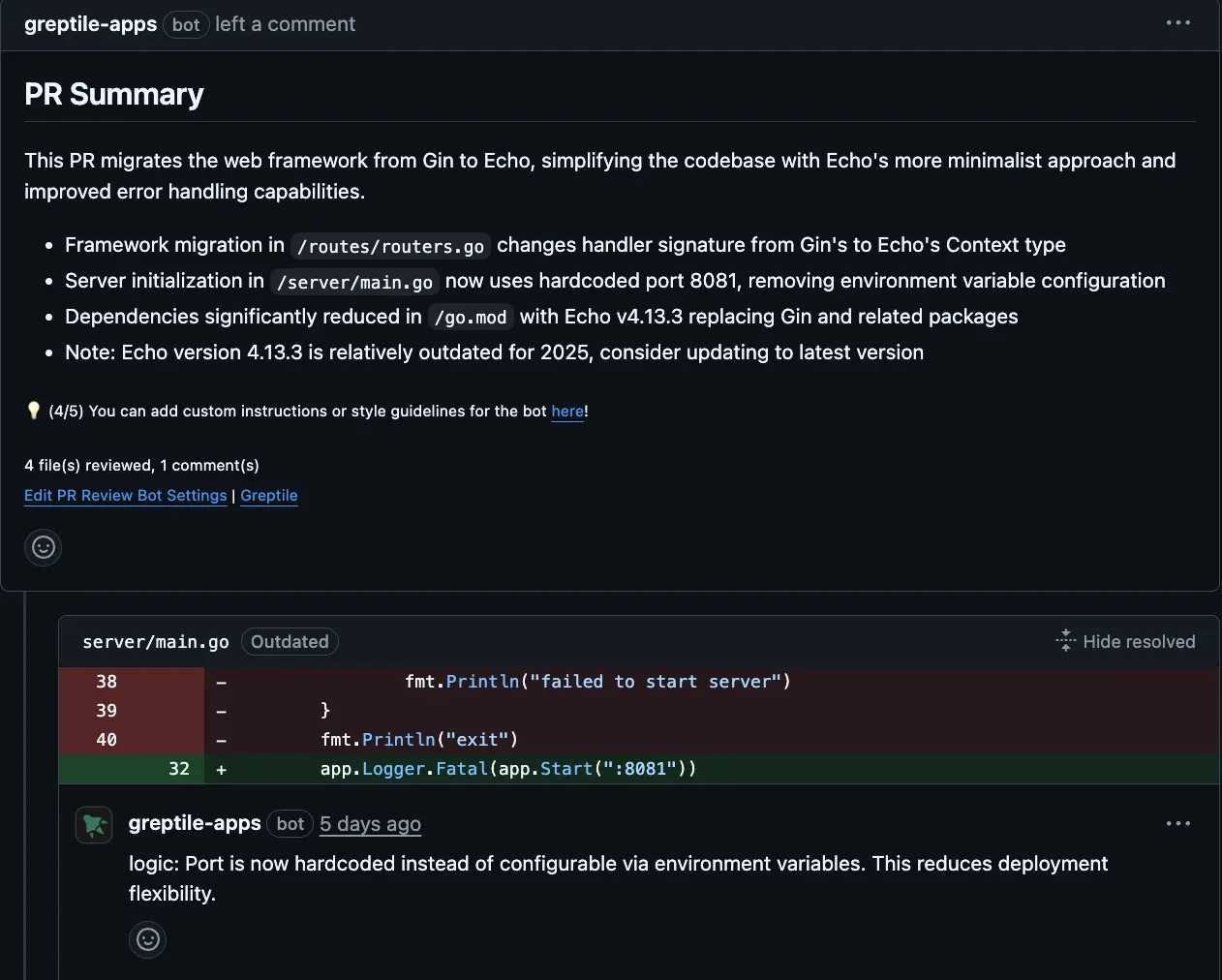
Git platforms
Greptile integrates with GitHub and GitLab, and states explicitly that it “integrates seamlessly with GitLab in addition to GitHub”.
That is two of the four major platforms. Teams on Bitbucket or Azure DevOps are not served, and this is the clearest structural limitation in the product. It is also the point where CodeRabbit has a concrete advantage, since it covers GitHub, GitLab and Bitbucket.
Check your platform before evaluating anything else. If you are on Azure DevOps, the rest of this review is academic.
Handing fixes to your editor
Greptile does something more interesting than posting comments and stopping. It offers IDE fixes that hand findings to Claude Code, Cursor, Codex and Devin, plus a Greptile MCP server for connecting to AI agents, a Claude Code plugin, and /greploop for iterative agent workflows.
The design intent is clear and correct for 2026: a reviewer that identifies a problem and then hands the fix to the agent already open on the developer’s machine closes a loop that would otherwise require the human to translate a comment into a change.
The MCP server matters for the same reason it matters elsewhere in this category. Rather than writing an integration, an MCP-capable agent connects and the capability is present.
Pricing
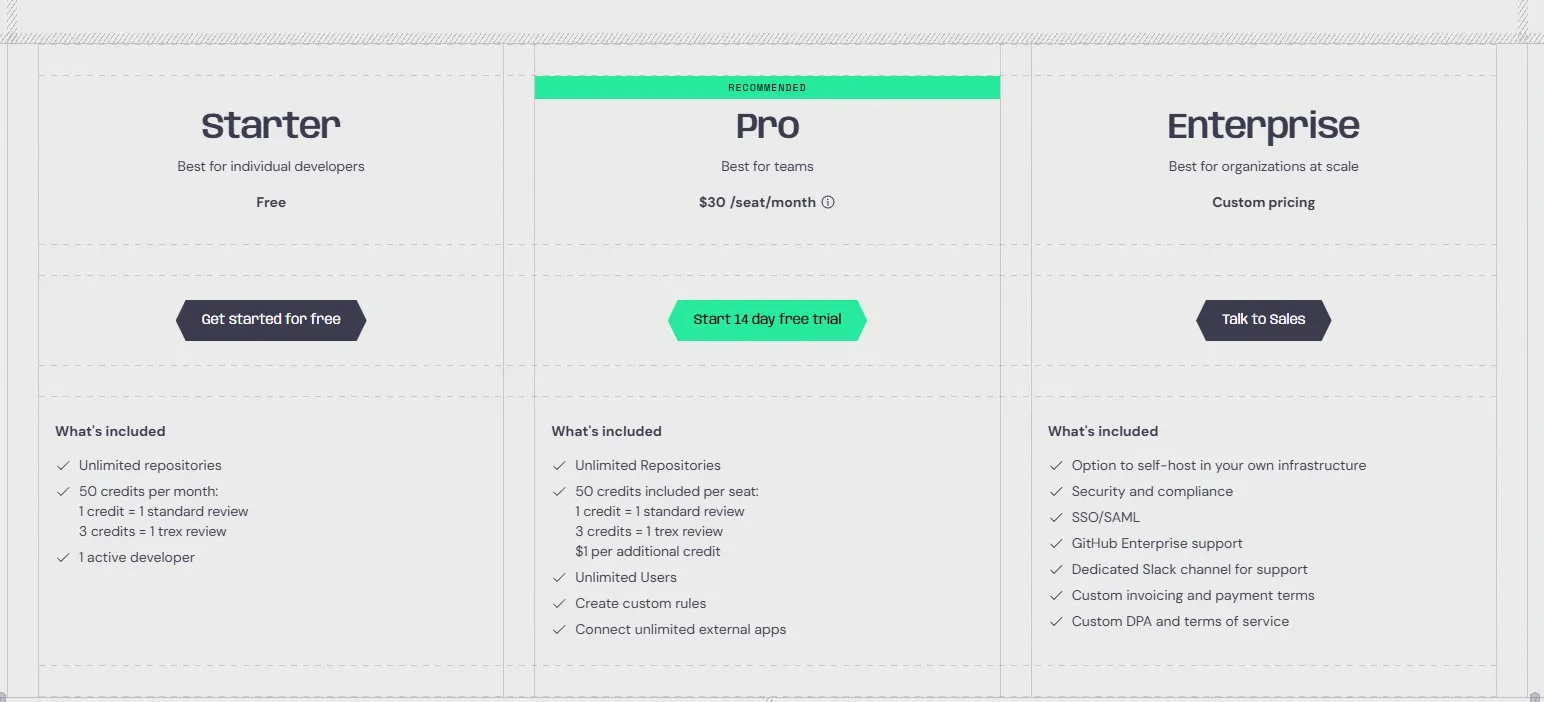
| Plan | Price | Includes |
|---|---|---|
| Starter | Free, billed monthly | 1 active developer, unlimited repositories, 50 credits per month |
| Pro | $30 per seat per month | Unlimited repositories, 50 credits per seat, custom rules, unlimited external app integrations, unlimited users, additional credits at $1 each |
| Enterprise | Custom | Option to self-host, security and compliance, SSO and SAML, GitHub Enterprise support, dedicated support, custom invoicing |
The credit system
Credits are the meter that determines your real cost, and the conversion is unusually clear: 1 credit is one standard review, and 3 credits is one TREX review.
At 50 credits per seat, a developer gets 50 standard reviews per month, or fewer if TREX reviews are used. Our own arithmetic: a developer opening 50 pull requests a month is at the limit exactly, and any re-review after pushing fixes consumes another credit.
For an active repository that is tight. Additional credits at $1 each are the release valve, and they are also the number to model. A developer running 100 reviews a month costs $30 plus $50 - effectively $80, not $30.
That is not a criticism of the pricing so much as a warning against reading the headline. Measure your monthly pull request volume per developer, including re-reviews, before budgeting.
The free tier is genuinely one seat
Starter covers one active developer with 50 credits. It is enough to evaluate the review quality on real work, which is the right purpose for a free tier, and not enough for a team.
What Enterprise unlocks
Self-hosting, SSO and SAML are Enterprise-only. If your security policy mandates single sign-on - which most organisations above a certain size do - the published $30 price does not apply to you and you are in a sales conversation from the start.
Security and Data Handling
This section deserves close reading, because Greptile’s posture has both the strongest option and the weakest default in this category.
The strongest self-hosting story we have reviewed
Enterprise customers can deploy Greptile in their own infrastructure, including air-gapped environments. Custom Apps are hosted on your own infrastructure - on-premises, in your virtual private cloud, or behind your virtual private network.
More unusually, customers who self-host Greptile can also self-host the language models rather than using OpenAI’s API platform for inference, or bring their own LLM by inserting their own base URL and keys.
That combination - the application, the index and the model all inside your perimeter - is a stronger isolation story than most tools in this category can offer, and for defence, finance or healthcare organisations it may be the deciding factor.
The default that needs changing
Here is the part that belongs in every evaluation.
By default, Greptile may use de-identified data for AI improvements. Customers can turn this off: “If you do not wish to permit Greptile to engage in AI training, you may manage preferences and settings related to AI training within your account.” For self-hosted deployments, “no Customer Data is collected or processed for machine learning purposes unless explicitly configured.”
Two observations follow.
First, this is opt-out rather than opt-in. A team that installs Greptile and starts reviewing without visiting settings is, by default, permitting de-identified data to be used for AI improvements. Whether that matters depends on your codebase and your obligations, but it should be a deliberate decision rather than a default nobody noticed.
Second, it is a materially different posture from CodeRabbit, which enforces Zero Data Retention with ephemeral in-memory processing and contractual guarantees that proprietary code is never used to train public or foundation models. Neither approach is wrong, but they are not equivalent, and the difference is one settings page away from mattering.
Certification, encryption and retention
- SOC 2 Type II compliant. “Customers may download a copy of Greptile’s SOC2 Type II report by reaching out to security@greptile.com.”
- Data is encrypted at rest and in transit, and “Greptile stores customer code on an encrypted filesystem on our servers.”
- Administrators can delete customer data at any time, with hard deletion within 24 hours.
- “Within 30 days following any termination or expiration, Customer may request return of Customer Data.”
- Infrastructure runs on AWS and Azure; inference uses OpenAI and Anthropic’s API platforms.
The 24-hour hard deletion window is a concrete commitment and better than the vague assurances common in this space.
The False Positive Question
No review of Greptile is honest without this section.
Third-party evaluations of AI code review tools consistently report the same pattern: Greptile catches the most issues in a single pass and produces the most false positives. Independent write-ups characterise it as the tool teams choose when they want a thorough standalone validation layer, and the tool that generates the most noise.
We have not run an independent benchmark, and we are deliberately not reproducing the specific percentages circulating for this category - the published figures contradict each other, with different sources reporting materially different detection and noise rates for the same products, and several of those sources are published by competing vendors.
What we can say is that the pattern is reported consistently enough across independent sources to treat as a real characteristic rather than a rumour, and that it follows logically from the architecture. A reviewer with full-repository context and parallel agents has more surface on which to find something, and more opportunity to flag something that is intentional.
Why this matters more than a detection score
The asymmetry in automated review is not symmetric. A missed defect costs you once - it reaches production, you find it, you fix it. A false positive costs you repeatedly: the engineer’s attention on that pull request, plus a fraction of their trust in every comment afterwards. Accumulate enough and the reviewer is mentally filtered out, at which point its correct findings are lost too.
This is why Greptile’s learning mechanism is not a nice-to-have but central to whether it works for you. A reviewer that adapts to your standards over time converts from noisy to precise. One that is never given feedback does not.
Practical guidance: if you trial Greptile, engage with its comments rather than ignoring them, configure custom rules on Pro, and give it long enough for the learning loop to show. Judging it on week one measures the wrong thing.
Who Should Use Greptile, and Who Should Not
Strong fit: teams with large, interconnected codebases where cross-file impact is the defect class that hurts; organisations that need self-hosting, air-gapped deployment or their own language models inside their perimeter; teams on GitHub or GitLab who want a thorough standalone validation layer; teams willing to engage with the reviewer so its learning loop works.
Poor fit: teams on Bitbucket or Azure DevOps, where it is not an option at all; teams with low tolerance for review noise who will not invest in tuning; organisations requiring single sign-on but unable to reach an Enterprise agreement; teams whose data policy cannot accommodate an opt-out default for AI training without a settings change.
Head-to-Head Comparisons
- Greptile vs CodeRabbit: the central comparison in this category, and a genuine contest. Greptile builds a graph index and runs parallel agents; CodeRabbit builds an AST call graph with over 40 deterministic linters alongside the AI layer. CodeRabbit covers more Git platforms and enforces Zero Data Retention by default; Greptile offers deeper self-hosting including your own models. Full breakdown in CodeRabbit vs Greptile.
- Greptile vs TestDriver.ai: complementary rather than competing. Greptile reviews the code in a pull request; TestDriver.ai runs the application built from it. Both are pull request gates at different layers.
- Greptile plus a coding assistant: the IDE fix handoff to Claude Code, Cursor, Codex and Devin means Greptile is designed to sit alongside whatever assistant your team already uses rather than replace it. See our guide to choosing an AI coding assistant.
Product description, indexing architecture, platform support, pricing and security posture in this review were verified against greptile.com, its pricing page and its security page on 16 August 2026. Credit-to-review conversions are our own arithmetic from Greptile’s published rates. Adoption and customer figures are published by Greptile and labelled as such. Characterisations of false positive rates reflect a pattern reported consistently across independent evaluations rather than a benchmark we have run, and specific percentages have been omitted because published figures contradict one another and several sources are competing vendors.
Evaluation Metrics
Accuracy in parsing call graphs, types, and catching subtle edge cases without noise.
Average execution time under 45s across PR triggers on GitHub Actions & GitLab CI.
Detection rate of OWASP Top 10 flaws, SQL injection risks, and leaked API secrets.
Time saved per senior reviewer and ease of interactive inline PR code chat.
Pros & Cons
What We Like (Pros)
- Builds a graph of files, functions and dependencies rather than reading the diff in isolation
- Parallel agents assess impact beyond the changed lines
- Enterprise can self-host in a VPC or air-gapped environment, including the language models
- Learns your standards over time by reading engineer comments on its reviews
Considerations (Cons)
- AI training on de-identified data is on by default and must be turned off in settings
- Supports GitHub and GitLab but not Bitbucket or Azure DevOps
- Third-party evaluations consistently report higher false positive rates than the category average
- Single sign-on and self-hosting are Enterprise-only
Greptile vs the Closest Alternatives
Alternatives named in this review, not tools that merely share a category.
| Feature Matrix |  Greptile Reviewed Tool |  CodeRabbit |
|---|---|---|
| Rating Score | 4.8 / 5.0 | 4.9 / 5.0 |
| Pricing Model | Starter free (50 credits) • Pro $30/seat/mo • Enterprise custom | 14-Day Free Trial • Free for Open Source • From $24/user/mo |
| Best For | Teams with large, interconnected codebases where cross-file impact is the defect class that hurts; organisations that need self-hosting, air-gapped deployment or their own language models inside their perimeter. | Engineering teams reviewing pull requests on GitHub or GitLab who want AST-aware, context-mapped feedback; open-source projects, which the platform is free for. |
| Key Differentiator | Graph index of files, functions and dependencies, for cross-file impact | AST-level pull request review with repository-wide context on GitHub and GitLab |
| Action / Review | Try Free | Read Review |
Full breakdown: Greptile vs CodeRabbit.
Frequently Asked Questions
Does Greptile train AI models on private repository code?
No. Greptile strictly adheres to zero-data-retention standards. Code diffs and repository context are processed in ephemeral memory for the duration of the review execution and are never stored or used to train public models.
How do I configure custom coding standards and linters?
Greptile reads a repository configuration file placed in the root directory. You can define rule severity, exclude specific paths, set language guidelines, and prompt instructions matching your team's style guide.
Is Greptile free for open-source software projects?
Public open-source repositories hosted on GitHub and GitLab receive free automated reviews with no cap on the number of repositories, pull requests, or contributors.
Which languages and frameworks does Greptile support?
Greptile covers the mainstream ecosystem - TypeScript/JavaScript, Python, Go, Java, Ruby, PHP, Rust, and C# - along with infrastructure-as-code formats such as Terraform, Dockerfiles, and Kubernetes manifests.
How does Greptile handle security scanning?
Greptile scans every incoming commit for hardcoded API keys, database credentials, SQL injection risks, and OWASP Top 10 security vulnerabilities before code is merged into production. High-priority security alerts are flagged directly inline within the pull request.


