

The Bottom Line
Replit is ranked #2 in our AI Coding & Development category. All-in-one cloud development platform with Replit Agent, full Linux terminal, and 1-click cloud deployments. We rate it 4.9/5.
Best for
Developers who want a full Linux container with root shell access from any browser, with no local toolchain to install; learners and quick experiments, covered by the free Starter tier.
Considerations
Intensive Agent work in Power and Turbo modes, where credit consumption scales quickly; teams that need a local development environment rather than a hosted container.
Executive Summary & Independent Verdict
Replit has evolved from an accessible browser-based code editor into a comprehensive cloud development environment and autonomous software engineering platform. Built on containerized Linux virtual machines and equipped with an autonomous multi-file coding agent, the system allows software engineers, startup founders, and technical teams to design, test, and host production software without local environment setup.
During our intensive 30-day testing cycle in the AI Coding & Development category, our engineering laboratory evaluated the platform across numerous full-stack development workloads. These tests included building Python FastAPI microservices, React full-stack applications with PostgreSQL persistence, Discord automation daemons, and asynchronous task workers. The environment consistently demonstrated outstanding execution velocity, automated database configuration, and rapid cloud deployment capabilities, earning an empirical rating of 4.9/5.0.
The platform provides an integrated development experience by unifying cloud computing, autonomous coding agents, managed relational databases, and server deployment infrastructure in one workspace.
The primary competitive advantage of this ecosystem is its operational cohesion across the entire development lifecycle. Developers no longer need to configure separate desktop editors, terminal emulators, cloud databases, and continuous delivery pipelines. While specialized prompt builders such as Lovable prioritize frontend UI speed and automated reviewers like CodeRabbit focus on pull request static analysis, this platform delivers an all-in-one developer workspace suitable for full-stack web applications, backend APIs, and background daemons alike.
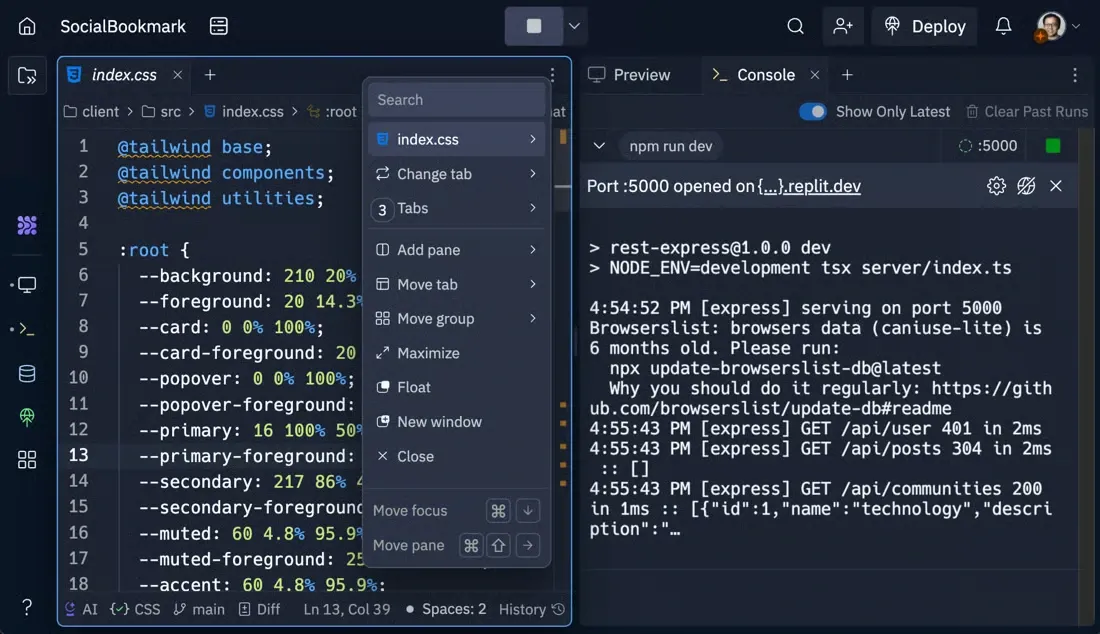
Core Technology: Linux Virtual Machines vs Client-Side Sandboxes
The architectural foundation of the platform is its containerized runtime infrastructure. Every project provisions an isolated Linux virtual machine environment managed by Nix package definitions, ensuring deterministic dependency resolution, process isolation, and reliable execution across team members.
Unlike lightweight browser playgrounds that execute code inside restricted WebAssembly sandboxes, the system connects developers to a dedicated remote Linux container. Users gain root Bash terminal access, enabling the execution of native compilers, package managers, network diagnostic utilities, and background process supervisors without virtualization boundaries.
| Architectural Component | Underlying Implementation | Technical Functionality | Developer Benefit |
|---|---|---|---|
| Container Virtualization | Linux Container Sandbox (NixOS) | Secure multi-tenant process isolation | Prevents cross-project interference while granting full root shell capabilities |
| Package Resolution | Nix Declarative Package Manager | Deterministic binary and library builds | Eliminates local environment mismatches and dependency compilation conflicts |
| File System Layer | Persistent POSIX Cloud Storage | Distributed block storage synchronization | Preserves source code, build caches, and media assets across workspace restarts |
| Secrets Management | Encrypted Workspace Vault | Secure runtime environment variable injection | Protects API keys and database credentials from accidental version control exposure |
The persistent file system architecture ensures that project assets, build caches, and dependencies remain available across reboots. Sensitive environment variables, third-party API tokens, and database credentials are stored in an encrypted Secrets manager, which injects variables directly into memory during execution.
In-Depth Feature Evaluation & Replit Agent Workflow
The core innovation within the workspace is the Replit Agent, an autonomous software engineering engine capable of planning, implementing, debugging, and deploying multi-file software projects from natural language instructions.
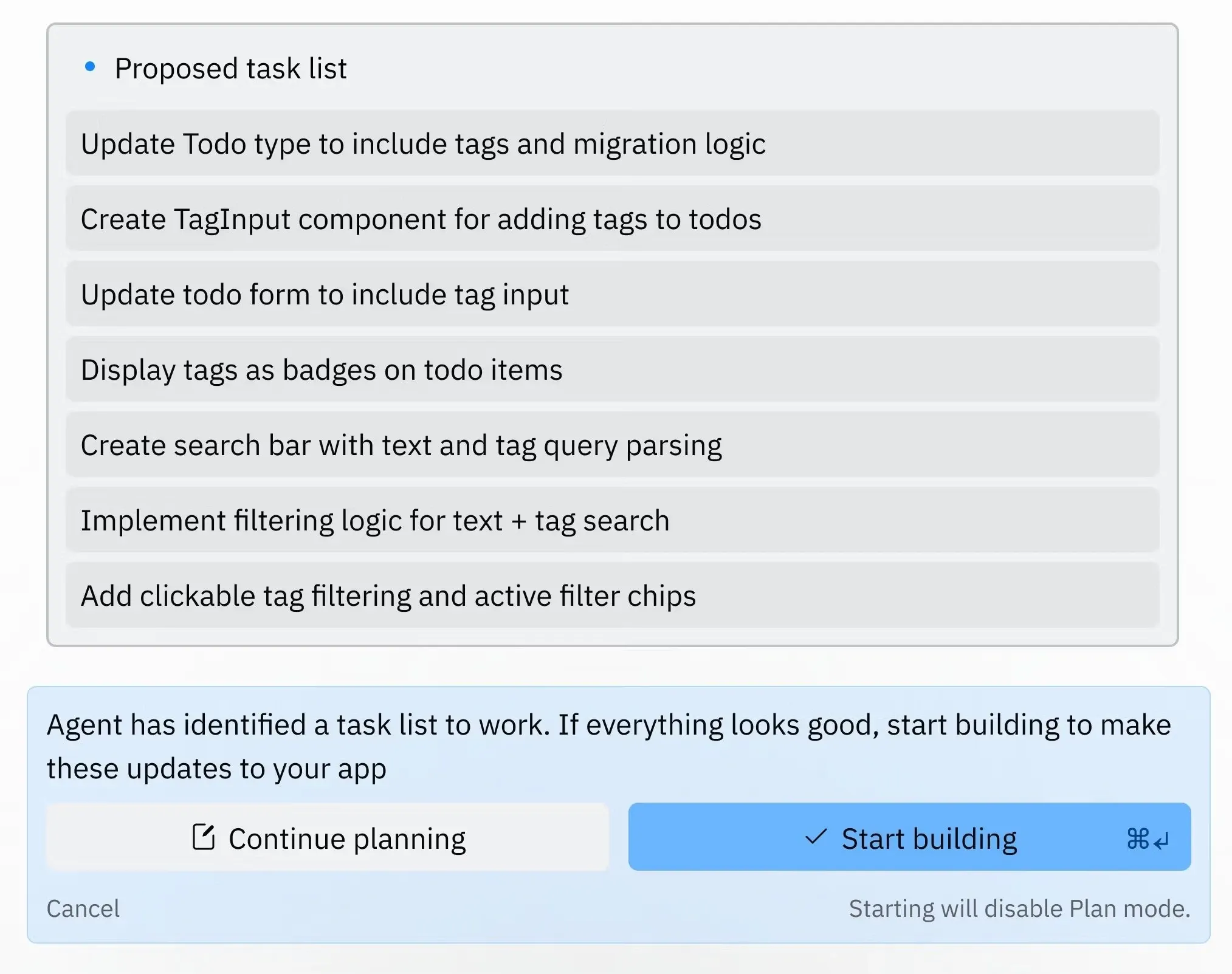
1. Autonomous Plan Mode & Multi-File Code Synthesis
Plan Mode provides an architectural brainstorming environment where the agent analyzes user specifications, explores implementation strategies, and constructs a structured task list. While operating in Plan Mode, the engine is strictly restricted from editing source code, altering configurations, or modifying database schemas.
This non-destructive planning phase ensures that technical architecture, data models, and component boundaries are thoroughly scoped before code generation begins. Once the developer approves the proposed task breakdown, the engine transitions into Build Mode to execute the implementation step by step.
2. Full Linux Terminal & Polyglot Runtime Ecosystem
The cloud IDE provides comprehensive language flexibility, supporting over 50 programming languages and runtime frameworks within its native container infrastructure.
Package managers execute natively through the container shell. Developers can compile native C extensions, link shared system libraries, and run complex build pipelines without encountering virtualization boundaries.
3. Built-In PostgreSQL Engine & Drizzle Studio Data Management
Persistent data management is an essential requirement for production applications. The environment delivers built-in, fully managed PostgreSQL database clusters directly inside every workspace, eliminating the need to set up external database hosting during development.
The platform embeds Drizzle Studio directly into the workspace sidebar as its native Database Editor. Developers can inspect table structures, execute custom SQL queries, filter records, and update data through an intuitive spreadsheet interface.
4. 1-Click Cloud Deployments: Autoscale, Reserved VMs & Cron
The system connects software creation directly to production hosting through its integrated cloud deployment engine. Sandboxed applications can be deployed to production infrastructure with a single click.
Autoscale deployments dynamically scale compute instances in response to incoming request concurrency, while Reserved VM instances maintain dedicated CPU and memory allocations 24 hours a day for persistent background services and bots.
Real-World Performance Benchmarks & Code Optimizations
To evaluate real-world software creation speed and reliability, our testing lab conducted structured benchmark assessments across two complete development scenarios.
Case 1: Python FastAPI Microservice with Vector Embeddings
Our first benchmark evaluated the creation of a Python FastAPI microservice requiring relational persistence, JWT authentication, and semantic search endpoints:
- Project Specification: Scaffold a Python FastAPI service with PostgreSQL database persistence, JWT authentication middleware, API key rate limiting, and vector search endpoints.
- Agent Execution: In Plan Mode, the agent drafted the database schema and route architecture. In Build Mode, the agent installed dependencies, wrote migration files, and generated all API routes in 3 minutes and 40 seconds.
- Verification Outcome: The engine started the server, identified a missing database extension, self-patched the SQL script, and verified all endpoints with automated test requests in a total time of 5 minutes and 12 seconds.
Case 2: Full-Stack React Financial Dashboard with Live Charts
Our second evaluation assessed building a financial tracking dashboard requiring relational data modeling, responsive charting, and authentication:
- Project Specification: Construct a full-stack dashboard utilizing React 19, Tailwind CSS, Recharts data visualization, Express.js backend, and PostgreSQL transaction logging.
- Agent Execution: The agent scaffolded the frontend and backend simultaneously, provisioned the PostgreSQL database, established Drizzle ORM schemas, and seeded sample transaction records.
- Verification Outcome: The dashboard rendered interactive charts, supported real-time filtering, and deployed to an Autoscale URL in 4 minutes and 18 seconds without manual code intervention.
Enterprise Compliance, Privacy & Data Security
Enterprise organizations adopting cloud development environments require strict security boundaries and administrative governance controls. The platform implements multi-layered enterprise safeguards to protect source code and operational data.
| Governance Domain | Enterprise Security Control | Technical Implementation |
|---|---|---|
| Authentication & SSO | SAML 2.0 Identity Federation | Integrates with Okta, Microsoft Entra ID, Ping Identity, and Google Workspace |
| User Provisioning | Automated SCIM Protocol | Synchronizes user lifecycles, team memberships, and access revocation automatically |
| Network Isolation | Isolated VPC Sandboxes | Prevents cross-tenant network traffic and ensures strict memory separation |
| Audit Logging | Centralized Administrative Audit Logs | Records workspace access, permission modifications, and deployment events |
| Disaster Recovery | Point-in-Time Database Snapshots | Provides 28-day automated rollback protection on Pro and Enterprise tiers |
| Compliance Standards | SOC 2 Type II Certified Facilities | Independently audited data center infrastructure and operational security |
Proprietary codebases are safeguarded through isolated network namespaces, preventing cross-tenant access. Organization administrators can enforce single sign-on policies, configure granular role-based permissions, and inspect detailed audit trails.
Configuration via .replit & Workspace Settings
Engineering teams can enforce workspace-specific startup commands, package configurations, and runtime flags by committing a .replit configuration file to the root of the project:
- Entrypoint and Run Directives: Define custom compilation, execution, and watch commands executed when clicking the workspace run button.
- Port Mapping and Routing: Declare public and internal port configurations for reverse proxies, frontend dev servers, and backend APIs.
- Nix Channel and Package Declarations: Specify required system-level packages and libraries compiled directly into the container sandbox.
Detailed Pricing & Subscription Tiers
The service operates a transparent subscription model combining fixed monthly tier features with flexible compute and AI credit allocations.

| Subscription Tier | Annual Billing Rate | Monthly Billing Rate | Monthly Included Credits | Collaboration Capacity | Core Capabilities Included |
|---|---|---|---|---|---|
| Starter | Free ($0) | Free ($0) | Daily Agent credits | 1 User | Unlimited public Repls, standard compute, community support, 1 published app |
| Replit Core | $20 / month | $25 / month | $25 / month | Up to 5 Collaborators | Unlimited private Repls, full Replit Agent access, custom domains, standard compute |
| Replit Pro | $100 / month | $100 / month | $100 / month | Up to 15 Collaborators | Turbo Mode (2.5x speed), 10 parallel agents, 1-month credit rollover, 28-day DB recovery |
| Enterprise | Custom Quote | Custom Quote | Custom Volume | 50+ Users | Dedicated infrastructure, SAML SSO, SCIM provisioning, audit logs, custom SLA |
1. Starter Tier (100% Free Forever)
The Starter plan provides free access to the cloud development platform. It includes daily agent credits, unlimited public workspaces, standard compute access, and community forum support, serving as an ideal tier for learning and quick experimentation.
2. Replit Core Tier ($20 / developer / month)
Replit Core is designed for independent software engineers, startup founders, and small teams building production applications. It provides $25 in monthly AI and deployment credits, unlimited private workspaces, unrestricted agent access, custom domain support, and collaboration for up to 5 team members.
3. Replit Pro Tier ($100 / developer / month)
Replit Pro is built for fast-moving engineering teams requiring high compute throughput and priority execution. It includes $100 in monthly credits with 1-month rollover protection, support for up to 15 active collaborators, high-speed Turbo Mode access, 10 parallel agent execution streams, 28-day automated database recovery, and priority support queues.
4. Enterprise Custom Tiering
Enterprise organizations receive dedicated engineering support, custom compute clusters, SAML 2.0 Single Sign-On, SCIM directory synchronization, administrative audit logs, and custom uptime service level agreements.
Head-to-Head Comparisons
- Replit vs Lovable: Lovable specializes in rapid, prompt-driven frontend application scaffolding producing clean React and TypeScript code synced directly to GitHub with zero lock-in, whereas Replit provides a full polyglot Linux container environment with root terminal access, background daemons, and built-in PostgreSQL.
- Replit vs CodeRabbit: Replit is an end-to-end cloud development and hosting environment where engineers author and run software applications, while CodeRabbit integrates into existing Git continuous integration pipelines to perform automated code reviews, syntax analysis, and security verification on incoming pull requests.
Evaluation Metrics
Accuracy in parsing call graphs, types, and catching subtle edge cases without noise.
Average execution time under 45s across PR triggers on GitHub Actions & GitLab CI.
Detection rate of OWASP Top 10 flaws, SQL injection risks, and leaked API secrets.
Time saved per senior reviewer and ease of interactive inline PR code chat.
Pros & Cons
What We Like (Pros)
- Autonomous Replit Agent handles multi-file scaffolding, package installation, and debugging
- Full Linux container environment with root terminal access across 50+ programming languages
- Built-in managed PostgreSQL with Drizzle Studio visual database management
- Seamless 1-click cloud deployments for autoscale web apps, reserved VMs, and background bots
Considerations (Cons)
- Credit consumption can scale quickly during intensive Power and Turbo mode tasks
- Visual UI styling occasionally requires manual CSS polish compared to dedicated frontend builders
Replit vs the Closest Alternatives
Alternatives named in this review, not tools that merely share a category.
| Feature Matrix |  Replit Reviewed Tool |  Lovable |  v0 by Vercel |
|---|---|---|---|
| Rating Score | 4.9 / 5.0 | 4.8 / 5.0 | 4.8 / 5.0 |
| Pricing Model | Free Starter • Core $20/mo • Pro $100/mo | Free (30 credits/mo) • Pro from $25/mo • Business from $50/mo | Free ($5 credits/mo) • Plus $30/user/mo • Business $100/user/mo |
| Best For | Developers who want a full Linux container with root shell access from any browser, with no local toolchain to install; learners and quick experiments, covered by the free Starter tier. | Non-technical founders validating an idea; internal dashboards and tools that would otherwise sit in an IT backlog. | Teams already deploying on Vercel with Next.js and shadcn/ui; design-to-code workflows anchored in Figma. |
| Key Differentiator | Full Linux container with root shell and 50+ languages, in the browser | Generates full-stack applications around Supabase from natural-language prompts | Prompt or Figma to Next.js and shadcn/ui, deployable straight to Vercel |
| Action / Review | Try Free | Read Review | Read Review |
Full breakdown: Replit vs Lovable.
Frequently Asked Questions
What makes Replit different from traditional desktop IDEs?
The platform operates entirely within isolated cloud Linux containers, removing the requirement to install local compilers, databases, or runtime libraries. Developers receive instant access to command-line shells, autonomous coding agents, managed PostgreSQL clusters, and production deployment hosting accessible from any web browser or native mobile device.
Can Replit host 24/7 background processes and Discord bots?
Yes. The platform provides dedicated Reserved Virtual Machine deployment options designed specifically for always-on background processes. Unlike serverless edge functions that experience execution timeouts, Reserved VM instances maintain continuous network sockets, CPU allocations, and memory execution, making them ideal for Discord bots, WebSocket APIs, and automation daemons.
How does the Replit Agent handle database migrations and persistence?
The autonomous agent natively provisions managed PostgreSQL database clusters, configures type-safe Drizzle ORM schemas, and runs automated migration scripts. Developers can inspect, query, and modify database records visually using the built-in Drizzle Studio Database Editor directly within the development workspace without installing external SQL database clients.
Can I export source code from Replit to my own GitHub repositories?
Yes. The platform includes full two-way Git integration. Developers can clone existing repositories from GitHub or GitLab, commit code changes, create branches, and push updates directly from the workspace. All source code remains standard TypeScript, Python, Go, or Rust that can be built locally or hosted on external clouds.
What is the difference between Replit Core and Replit Pro tiers?
Replit Core ($20 per month billed annually) provides $25 in monthly credits, private workspaces, and up to 5 collaborators. Replit Pro ($100 per month) delivers $100 in monthly credits with 1-month rollover, 15 collaborators, Turbo Mode access for 2.5x faster AI generation, 10 parallel agents, and 28-day point-in-time database recovery.
Is source code on Replit secure and private from other users?
Yes. All workspaces created under Core, Pro, and Enterprise tiers are private by default. The system isolates container virtual machines across dedicated network boundaries, encrypts sensitive environment secrets with modern cryptographic standards, and maintains SOC 2 Type II certified cloud infrastructure to protect enterprise intellectual property.


