

The Bottom Line
Dub.co is ranked #3 in our Business & Productivity category. Link analytics plus affiliate program infrastructure with a real API. We rate it 4.8/5.
Best for
Companies running affiliate or referral programmes at meaningful payout volume; SaaS teams that need conversion attribution they can audit and defend.
Considerations
Anyone who just wants short links, where the price is disproportionate to the need; programmes whose total payouts are below the $90 monthly cost of managing them.
Executive Summary & Independent Verdict
Dub.co began life as an open-source URL shortener, and a great deal of the writing about it still describes that product. It has moved on considerably.
Today it splits into two halves: Dub Links - link management and analytics - and Dub Partners, infrastructure for running affiliate and referral programmes. That second half is now the centre of gravity, and it changes who the product is for entirely.
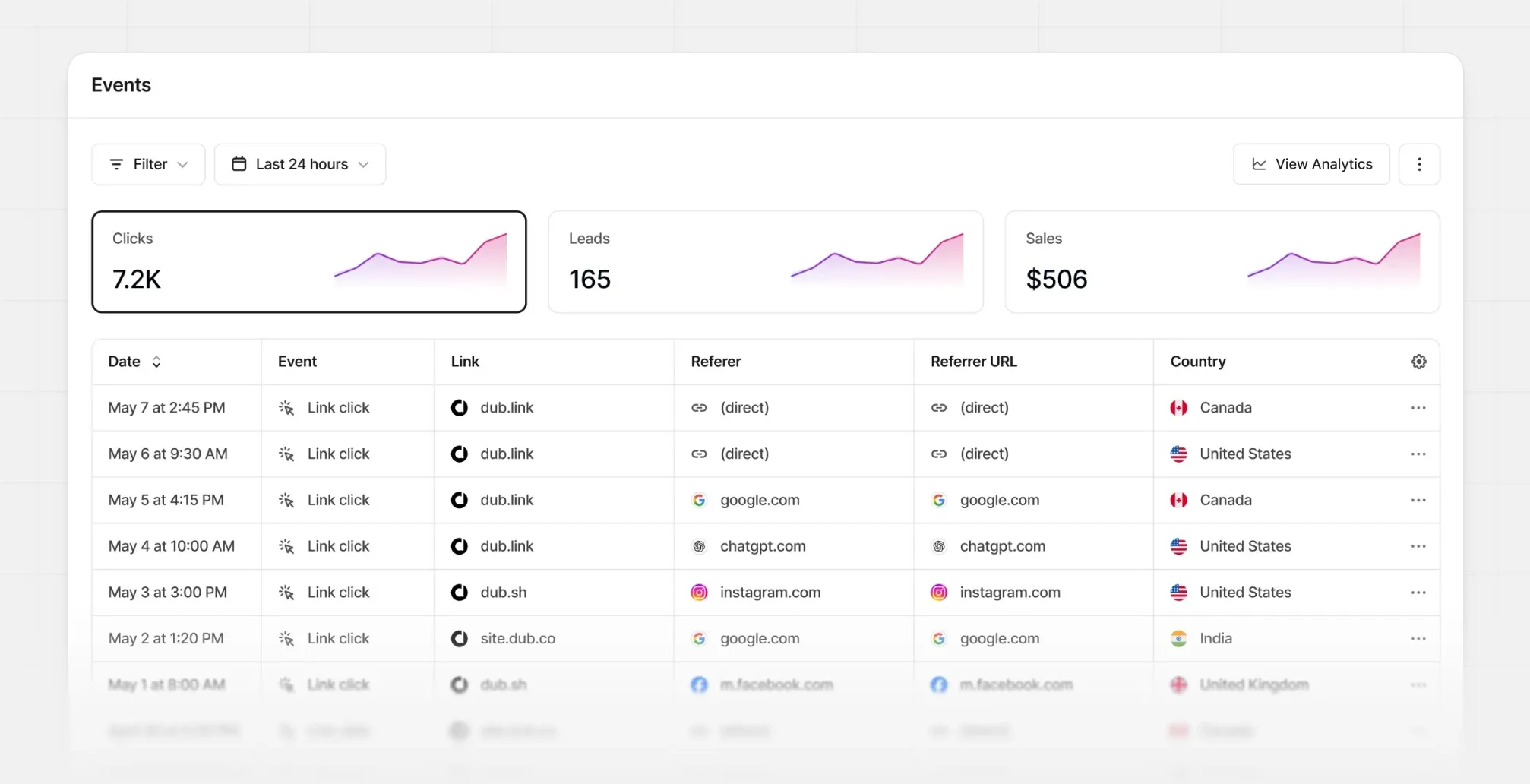
If you want to shorten a URL, Dub has become expensive for the job - and that is not a criticism, it is a repositioning. If you are running a partner programme and need attribution you can defend when a partner disputes a payout, it is one of very few options with a genuine API underneath it rather than a dashboard with an export button.
One disclosure before anything else. The search results for “Dub.co review” are dominated by direct competitors - at least two of the highest-ranking reviews are published by rival link platforms - and by affiliate content. We have no commercial relationship with any of them, and we have not used those sources for factual claims in this review.
We place Dub.co at #3 in Business & Productivity. It earns that on developer surface: the API, SDKs and webhook model are considerably more serious than the category norm.
From URL Shortener to Partner Infrastructure
The evolution
Dub started as an open-source URL shortener and grew into link management and then into affiliate infrastructure.
The open-source origin still shows in how the product is built. It is API-first, with the dashboard as one client among several rather than the only way in - which is why the developer surface described below is unusually complete for a product in this category. Tools built dashboard-first tend to bolt on an API later, and it shows.
The attribution argument
Dub launched its attribution product in direct response to the Honey browser extension controversy - an episode that moved affiliate attribution from a back-office detail to a subject of public argument, and left creators and merchants asking who was actually credited for a given sale and on what basis.
Dub’s positioning is transparent and auditable attribution: not a number handed down by a black box, but a record you can inspect and reconcile.
We are describing the stated positioning and the publicly reported event that prompted it. We are not making claims about any third party’s conduct, and readers evaluating attribution vendors should test the auditability claim against their own data rather than take it - or any competitor’s counter-claim - on trust. The correct evaluation is to run a known conversion through the system and confirm you can trace it end to end.
Two products, one platform
- Dub Links - link management, analytics, custom domains.
- Dub Partners - affiliate and referral programme management, rewards, payouts.
Knowing which one you need determines whether the pricing below is reasonable or absurd, and it is the first question to answer before evaluating anything else.
Dub Partners: What $90 per Month Actually Buys
Payout caps are the real tier boundary
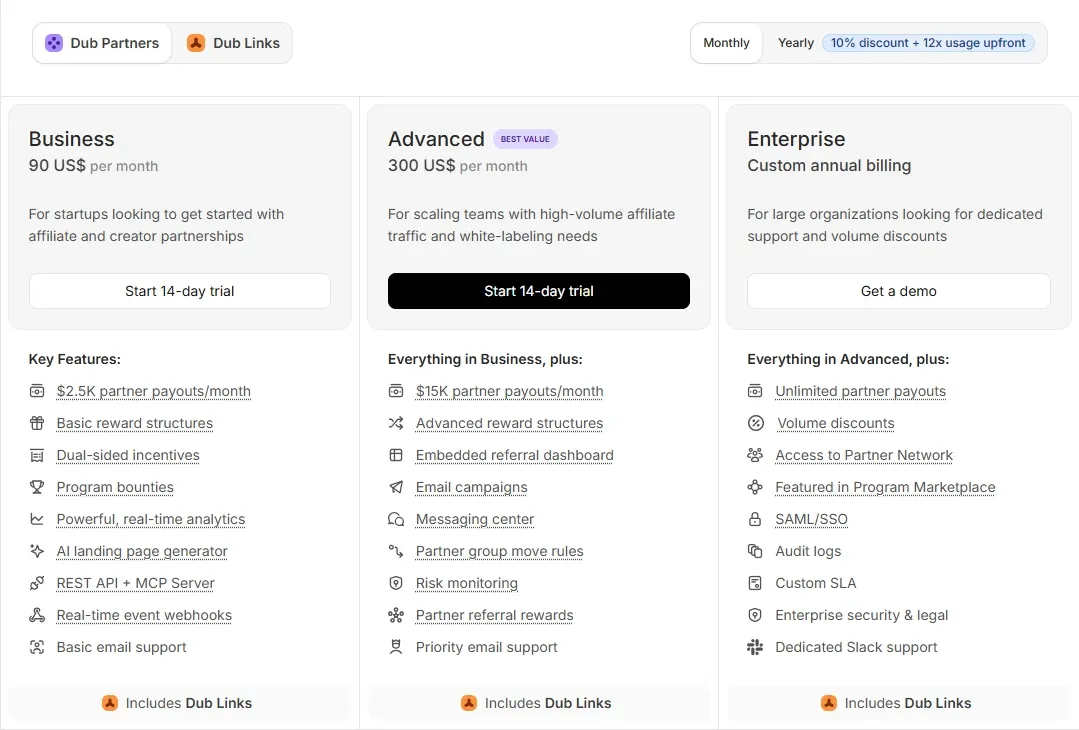
The number that determines which plan you need is not links, clicks or users. It is partner payout volume:
| Plan | Monthly payout cap |
|---|---|
| Business ($90) | $2,500 |
| Advanced ($300) | $15,000 |
| Enterprise | Unlimited |
A programme paying out more than $2,500 a month to partners is on Advanced regardless of how few links it uses. Model your payout volume first; everything else follows from it.
This is also the cleanest way to sanity-check whether Dub is worth its price. A programme paying $15,000 monthly to partners is generating substantially more than that in attributed revenue, against which $300 of infrastructure is a rounding error. A programme paying $500 a month is paying $90 to manage $500, which is a different conversation.
Business at $90 per month
Basic reward structures, dual-sided incentives, programme bounties, an AI landing page generator, REST API and MCP Server, real-time event webhooks, and basic email support.
That the API and MCP server appear at the entry paid tier - rather than being reserved for Enterprise, which is the industry habit - is the most developer-friendly decision in this pricing structure. It means you can build against Dub from day one rather than prototyping in the dashboard and rewriting later.
Advanced at $300 per month
Everything in Business plus advanced reward structures, an embedded referral dashboard, email campaigns, a messaging centre, partner group move rules, risk monitoring, partner referral rewards and priority support.
Risk monitoring is the feature that justifies the tier for a mature programme. Affiliate fraud is a real and recurring cost centre - self-referrals, cookie stuffing, incentivised traffic that converts and then refunds, partners bidding on your own brand terms. Detecting those patterns manually does not scale past a few dozen partners, and by the time a human notices, several payout cycles have completed.
The embedded referral dashboard matters commercially in a different way: partners see their own performance inside your product, under your brand, rather than on a third-party page. For a programme where partner experience affects recruitment, that is not cosmetic.
Enterprise
Unlimited payouts, volume discounts, Partner Network access, SAML single sign-on, audit logs, custom service levels, enterprise security and legal review, and dedicated Slack support.
Single sign-on and audit logs being Enterprise-only is worth noting for any organisation whose security policy mandates them. That requirement alone moves you off the published price list and into a negotiation, which is worth establishing early rather than discovering during a security review.
Developer Surface
This is where Dub separates itself from marketing-oriented link tools, and it is the strongest argument for choosing it.
REST API and MCP Server, from the Business tier. The MCP server is the notable inclusion in 2026. It means an AI agent can create links, read analytics and manage partners directly, without a bespoke integration layer sitting between the model and the platform. Few tools in this category have shipped that, and it puts Dub in the same architectural bracket as Zernio - infrastructure designed to be called by software rather than operated by people.
SDKs in five languages - TypeScript, Python, Go, Ruby and PHP. Broad enough that most backends can integrate natively rather than hand-rolling HTTP calls and re-implementing retry logic.
Real-time event webhooks. Clicks and conversions are pushed to your systems as they happen. This is what makes Dub usable as infrastructure inside a product rather than as a dashboard someone checks weekly - your application can react to a conversion in the moment, crediting a partner or unlocking a reward without a polling job.
AI landing page generator, included from Business, producing pages for partner campaigns.
What this enables architecturally
The combination is what matters. With an API to create links, webhooks to receive conversion events and an MCP server for agent access, Dub can sit inside your product as the referral layer rather than beside it as a tool.
A SaaS product can generate a unique referral link for every customer at signup, receive a webhook when that link converts, and credit the referrer automatically - with no human touching the affiliate platform at any point. That is a materially different proposition from a dashboard where someone creates links by hand.
Pricing and Limits
| Plan | Monthly | Annual | Tracked events | New links/month | Custom domains | Users |
|---|---|---|---|---|---|---|
| Business | $90 | $1,080, around $972 with the 10 per cent discount | 250K/month | 10K | 100 | 10 |
| Advanced | $300 | $3,600, around $3,240 with the discount | 1M/month | 50K | 250 | 20 |
| Enterprise | Custom | Custom | Unlimited | Unlimited | Unlimited | Unlimited |
Annual billing carries a 10 per cent discount, which is modest by category standards and means the commitment decision is close to neutral financially.
Cost per tracked event
Our own arithmetic, dividing monthly price by included tracked events:
| Plan | Monthly | Events | Cost per 1,000 events |
|---|---|---|---|
| Business | $90 | 250,000 | $0.36 |
| Advanced | $300 | 1,000,000 | $0.30 |
The volume discount between tiers is modest - around 17 per cent - which reinforces the point above that payout caps rather than event volume drive the tier decision. You do not upgrade to Advanced to get cheaper events; you upgrade because you have outgrown a $2,500 payout ceiling.
A note on lower tiers
At the time of verification, Dub’s pricing page displayed only the three tiers above.
Third-party sources describe a free plan and a lower-priced Pro tier belonging to the Dub Links side of the product, but we could not confirm those on the official pricing page, which currently presents the Partners tiers.
If you only need link management rather than partner infrastructure, ask Dub directly about Links-only pricing before assuming $90 is the entry point. We are not reproducing unconfirmed figures, and the gap between $0 and $90 is large enough that the answer changes the evaluation completely.
Evaluating Dub Against Building It Yourself
Because Dub is infrastructure rather than an application, the honest comparison for many teams is against building a referral system in-house. Four considerations decide it.
Attribution correctness is harder than it looks. Multi-touch journeys, cross-device conversions, refunds that should claw back a payout, and partners disputing a number all have to be handled. Most in-house systems handle the happy path and accumulate edge cases indefinitely.
Payouts involve money movement, which brings compliance obligations that are unrelated to your product and unwelcome in your codebase.
Fraud detection is a specialist problem. The risk monitoring on Advanced represents pattern detection that a team building a referral feature will not prioritise until after it has been exploited.
The counter-argument is control. If referral mechanics are genuinely core to your product’s differentiation, owning them may be worth the cost. For most companies they are important but not differentiating, which is exactly the profile that favours buying.
Who Should Use Dub, and Who Should Not
Strong fit: companies running affiliate or referral programmes at meaningful payout volume; SaaS teams that need conversion attribution they can audit and defend; product teams embedding partner functionality through API, SDK or MCP rather than operating it by hand; organisations that want partners to see performance inside their own product.
Poor fit: anyone who just wants short links, where the price is disproportionate to the need; programmes whose total payouts are below the $90 monthly cost of managing them; teams requiring single sign-on or audit logs but unable to reach an Enterprise agreement; buyers who need a published price for Links-only usage before committing.
Head-to-Head Comparisons
- Dub vs Bitly: different audiences entirely. Bitly targets marketers who want a dashboard and branded links; Dub targets engineering teams who want an API and a partner programme underneath their product. If nobody on your team will ever call the API, Dub’s main advantage is wasted.
- Dub vs Rewardful or PartnerStack: the genuine competitive set for Dub Partners. The differentiator is Dub’s developer surface - REST API, MCP server, five SDKs - against more marketing-oriented incumbents with deeper campaign tooling.
- Dub vs Zernio: not competitors, but the same shape of product. Zernio is a developer-first API with an MCP server for social platforms; Dub is the same pattern for links and partner programmes. Both are examples of marketing infrastructure sold as an API.
- Dub plus Fillout: adjacent tooling for the same funnel. Fillout captures and qualifies inbound interest; Dub attributes where that interest came from.
Plan pricing, tracked-event limits, payout caps and per-tier features in this review were verified against Dub’s official pricing page on 21 August 2026, which at that date displayed the Business, Advanced and Enterprise tiers. Cost-per-event figures are our own arithmetic. Lower-priced Dub Links tiers reported by third parties could not be confirmed and are deliberately not quoted. Several of the highest-ranking Dub reviews online are published by direct competitors. Confirm current terms at dub.co before purchasing.
Evaluation Metrics
Accuracy in parsing call graphs, types, and catching subtle edge cases without noise.
Average execution time under 45s across PR triggers on GitHub Actions & GitLab CI.
Detection rate of OWASP Top 10 flaws, SQL injection risks, and leaked API secrets.
Time saved per senior reviewer and ease of interactive inline PR code chat.
Pros & Cons
What We Like (Pros)
- REST API, MCP server and real-time webhooks available from the Business tier
- SDKs for TypeScript, Python, Go, Ruby and PHP
- Attribution built for auditability rather than opaque last-click reporting
- The Advanced tier adds risk monitoring against affiliate fraud
Considerations (Cons)
- Partner payouts are capped at $2.5K/month on Business and $15K/month on Advanced
- SAML SSO and audit logs are Enterprise-only
- Too expensive if all you need is link shortening
- Most published Dub reviews are written by direct competitors
Dub.co vs the Closest Alternatives
Alternatives named in this review, not tools that merely share a category.
| Feature Matrix |  Dub.co Reviewed Tool | Rewardful / PartnerStack Not reviewed here | Bitly Not reviewed here |
|---|---|---|---|
| Rating Score | 4.8 / 5.0 | Not rated by us | Not rated by us |
| Pricing Model | Free (3 domains, 1k events) • Pro $30/mo • Business $90/mo • Advanced $300/mo | Rewardful $49 to $149/mo - PartnerStack quote only | Free (5 links/mo) - Core $10/mo - Growth $35/mo, $29 annually |
| Best For | Companies running affiliate or referral programmes at meaningful payout volume; SaaS teams that need conversion attribution they can audit and defend. | Partner programmes run by marketing rather than engineering | Teams where nobody will ever call the API |
| Key Differentiator | Link infrastructure plus partner payouts, driven by REST API and MCP server | Marketing-oriented incumbents with deeper campaign tooling | A dashboard and branded links aimed at marketers, not an API |
| Action / Review | Try Free |
Frequently Asked Questions
Does Dub.co train AI models on private repository code?
No. Dub.co strictly adheres to zero-data-retention standards. Code diffs and repository context are processed in ephemeral memory for the duration of the review execution and are never stored or used to train public models.
How do I configure custom coding standards and linters?
Dub.co reads a repository configuration file placed in the root directory. You can define rule severity, exclude specific paths, set language guidelines, and prompt instructions matching your team's style guide.
Is Dub.co free for open-source software projects?
Public open-source repositories hosted on GitHub and GitLab receive free automated reviews with no cap on the number of repositories, pull requests, or contributors.
Which languages and frameworks does Dub.co support?
Dub.co covers the mainstream ecosystem - TypeScript/JavaScript, Python, Go, Java, Ruby, PHP, Rust, and C# - along with infrastructure-as-code formats such as Terraform, Dockerfiles, and Kubernetes manifests.
How does Dub.co handle security scanning?
Dub.co scans every incoming commit for hardcoded API keys, database credentials, SQL injection risks, and OWASP Top 10 security vulnerabilities before code is merged into production. High-priority security alerts are flagged directly inline within the pull request.


