

The Bottom Line
Shipixen is our top-ranked tool in Starter Kits & Boilerplates. Generates unlimited branded Next.js starter repos, not a single template. We rate it 4.9/5.
Best for
Agencies building sites for many clients, where the per-project cost collapses; indie developers launching several products a year.
Considerations
Anyone building one site; projects needing authentication, billing and a database.
Executive Summary & Independent Verdict
Almost every product in this category sells you a repository. You buy it, you clone it, you use it once, and the second project starts the process again - either with a second purchase or with a copy-paste job from the first.
Shipixen sells something structurally different: an application that generates repositories. You supply your branding, choose from its themes, and it produces a git repository - or a zip file - containing working code you own outright. Then you do it again for the next project, and the next, at no additional cost for the duration of your licence.
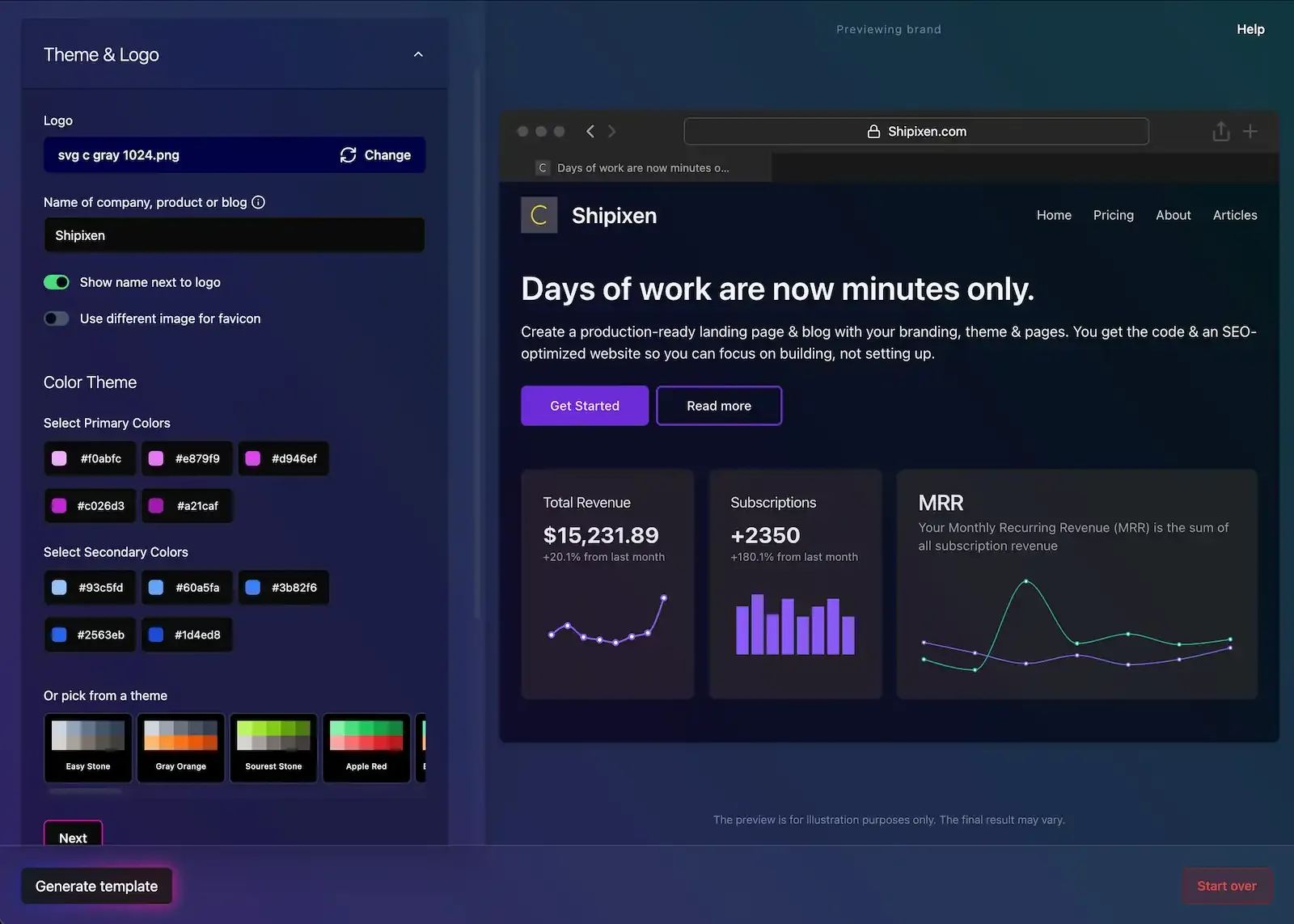
That difference changes the arithmetic entirely for anyone who ships more than one thing. It also means Shipixen is competing on a different axis from the SaaS boilerplates it is usually compared against - its output is marketing sites and blogs, not applications with authentication and billing.
We place Shipixen at #1 in Starter Kits & Boilerplates. It earns that on economics rather than feature count: for people launching repeatedly, nothing else in this category has a comparable cost curve.
Generator, Not Template: Why That Changes the Maths
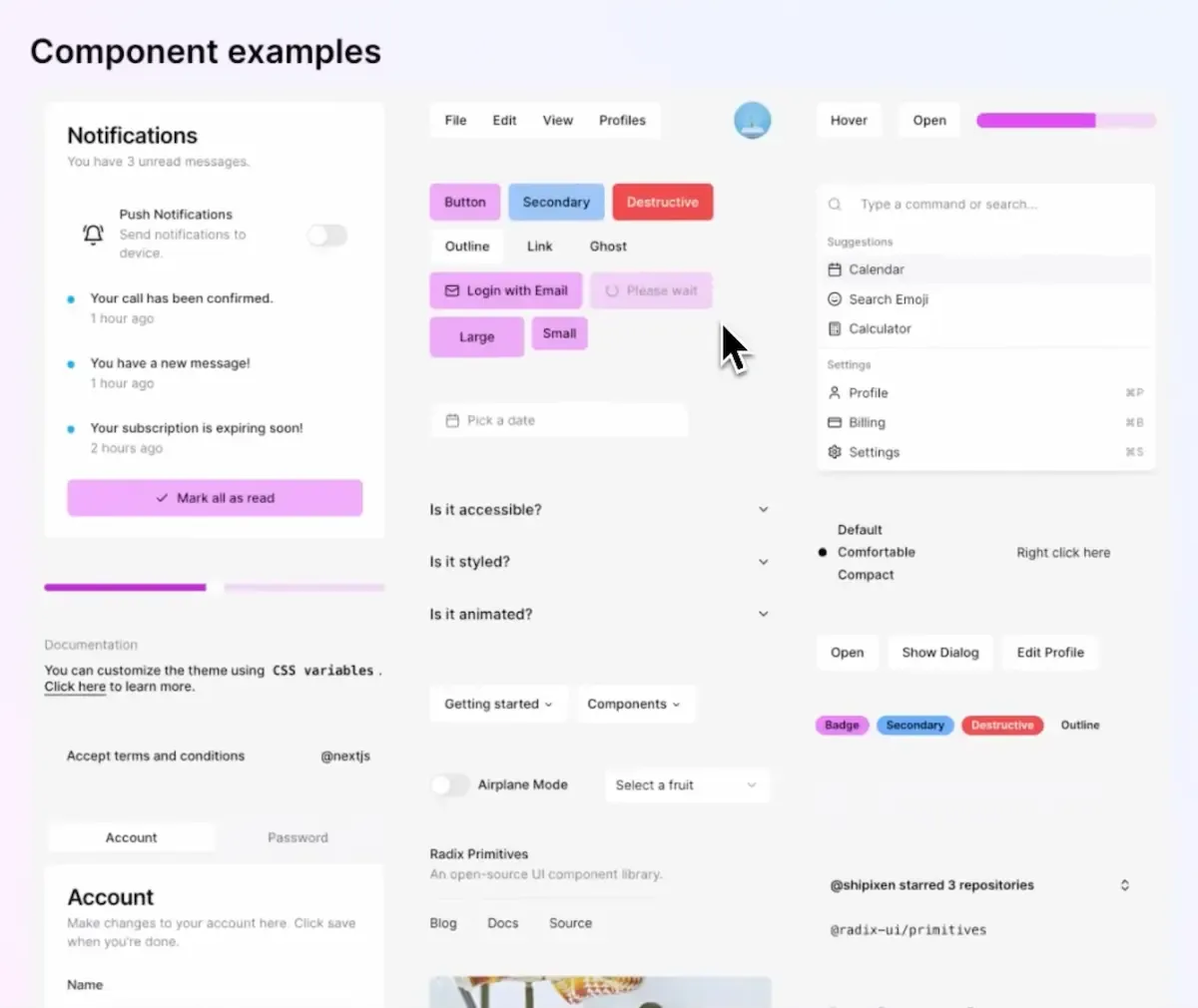
The workflow
You enter your branding and select from the available themes and page types. Shipixen produces a git repository or a zip file containing fully functional code that you can modify and deploy anywhere that supports Next.js.
There is no proprietary runtime, no hosted builder you must keep paying to edit in, and no export step that degrades the output. What you receive is an ordinary Next.js project that behaves exactly as if you had written it.
That last point is worth dwelling on, because it is what separates a generator from a site builder. A site builder holds your work; a generator hands it over and steps out of the way.
Unlimited generations
Both licences permit unlimited boilerplate generation for their duration. For an agency building sites for clients, or an indie developer launching several products a year, this is the entire commercial argument.
Our own arithmetic, comparing against a hypothetical single-use boilerplate at $199:
| Projects in one year | Single-use boilerplate at $199 each | Shipixen 1-Year at $249 | Saving |
|---|---|---|---|
| 1 | $199 | $249 | Shipixen costs $50 more |
| 2 | $398 | $249 | $149 |
| 5 | $995 | $249 | $746 |
| 10 | $1,990 | $249 | $1,741 |
The break-even sits between one and two projects. Below that, Shipixen is the more expensive choice and you should buy a template instead; above it, the gap widens quickly and keeps widening.
The code is yours permanently
This detail is frequently misunderstood and worth stating plainly: with the 1-Year licence, all generated code is owned permanently.
The licence governs your ability to generate new boilerplates. It does not govern your right to keep, modify, deploy or sell what you already generated.
If your licence lapses after twelve months, the five sites you built remain yours, deployable and modifiable, indefinitely. You simply cannot generate a sixth without renewing. For an agency that front-loads a year of client work, that is a materially better arrangement than a subscription whose expiry disables anything.
What You Get in the Box
The stack
- React and Next.js 15 with the App Router
- TypeScript
- Tailwind CSS
- Shadcn UI component library
- MDX powered by Contentlayer
- Lucide icons
This is a mainstream, current stack rather than an idiosyncratic one, which matters for the same reason it matters in Lovable’s output. A developer you hire in a year will recognise it immediately, and a client taking the site in-house will not need a specialist.
What it generates
- Landing pages built from conversion-oriented templates
- An MDX-powered blog with SEO optimisation
- Pricing, terms and privacy pages
- A customisable homepage and additional pages
- Pre-configured Vercel deployment
The pricing, terms and privacy pages deserve a mention because they are the sort of thing that takes an afternoon each time and produces no satisfaction whatsoever. Having them scaffolded is a small time saving repeated on every project.
The component library
- 63 or more themes
- 37 or more landing page components
- 300 or more usage examples
- 16 or more font pairings
- Dark mode and responsive design throughout
The blog implementation includes search, tags and pagination - the three things people always discover are missing after choosing a minimal blog starter, usually about two months in when there are enough posts for it to matter.
The font pairings are a smaller feature with a real effect. Typography is where most developer-built marketing sites visibly fail, and sixteen tested pairings removes a decision that most people making it are not equipped to make well.
SEO handled automatically
Favicon, meta tags and sitemap generation are automatic.
These are individually trivial and collectively an afternoon of fiddly work per project, repeated every single time, and frequently forgotten until a client asks why the site has no preview image on social media. Automating them is exactly the sort of thing a generator should do and exactly the sort of thing a template cannot.
AI content generation
Shipixen includes AI content generation. The scope is not fully specified on the site, and it is listed prominently under the Lifetime tier - see the licence section below for why that matters to the purchase decision.
Deployment
Deployment to Vercel is pre-configured and one click. Since the output is standard Next.js, it also runs on Netlify, Railway, or any host that supports the framework.
This is the anti-lock-in property that distinguishes a generator from a hosted site builder: the generated site has no dependency on Shipixen once it exists. Stop paying, and nothing you built stops working. There is no runtime call home, no licence check, and no feature that degrades.
For agency work specifically, that matters commercially. You can hand a client the repository and the hosting account without also handing them a dependency on a tool they did not buy and cannot administer.
Licence Terms: Read This Before Buying
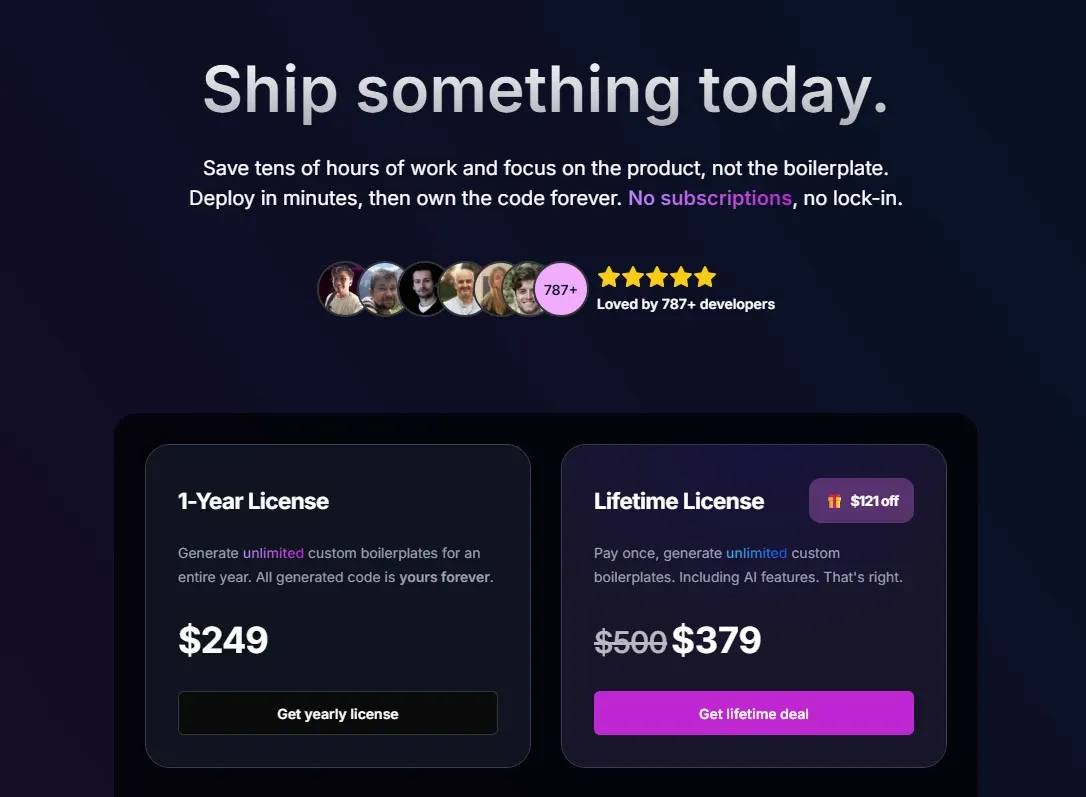
| Licence | Price | Terms |
|---|---|---|
| 1-Year | $249 | Unlimited boilerplate generation for one year; generated code owned permanently |
| Lifetime | $379, listed as “$500 - $121 off” | One-time payment, unlimited generation; includes AI features; permanent access to all updates |
Both include “unlimited free updates” while the licence is valid.
The one-device limit
Each licence is limited to one device. This is unusual for a developer tool, and it is the detail most likely to cause friction after purchase.
Most developers work across at least two machines - a desktop and a laptop, or a personal and a work machine, or a machine at home and one at a client site. A per-device licence means the generator is available on only one of them.
Whether reactivation on a new machine is straightforward is not documented. If you regularly switch hardware, or if you replace machines often, this is worth asking about before buying rather than discovering when you are on the wrong laptop with a deadline.
The constraint applies to the generator, not the generated code. The repositories you produce are ordinary git projects with no restrictions, and can be worked on from anywhere by anyone.
1-Year against Lifetime
The break-even is just over eighteen months, since $379 divided by $249 is approximately 1.52 years. (Our arithmetic.)
There is a complicating factor that may matter more than the break-even. The Lifetime tier explicitly lists AI features, and the 1-Year tier does not make its AI coverage clear.
If AI content generation is part of why you are buying, confirm whether the 1-Year licence includes it before choosing on price alone. That single question may settle the decision regardless of the eighteen-month calculation, and it is not answerable from the pricing page as published.
Where Shipixen Is the Wrong Tool
Being clear about scope prevents a bad purchase, and this product has a well-defined boundary.
It is not a full SaaS boilerplate. There is no authentication, no billing integration, no database layer, no team management. If you are building an application where users sign up and pay, TurboStarter addresses that and Shipixen does not - and no amount of theme selection closes that gap.
It is poor value for a single project. At $249 for one site, you are paying generator pricing for template use. Buy it because you will generate repeatedly, or buy something else.
Multi-machine workflows hit the device limit, as described above.
Who Should Use Shipixen, and Who Should Not
Strong fit: agencies building sites for many clients, where the per-project cost collapses; indie developers launching several products a year; anyone who needs a well-configured MDX blog with SEO handled rather than assembled; teams that want consistent visual quality across many marketing sites; developers who value owning standard Next.js output with no lock-in and no client-facing dependency.
Poor fit: anyone building one site; projects needing authentication, billing and a database; developers working across multiple machines who would hit the device limit regularly; teams whose stack is not React and Next.js.
Head-to-Head Comparisons
- Shipixen vs TurboStarter: the most important comparison in this category, and the two products barely overlap. Shipixen generates marketing sites and blogs, unlimited, with a per-device licence. TurboStarter delivers one SaaS foundation with authentication, billing and multi-platform targets, licensed for unlimited projects and devices. Establish what you are building before comparing prices, because the prices are close and the products are not.
- Shipixen vs starting from
create-next-app: you are paying for 63 themes, 37 landing components, a configured MDX blog and automatic SEO. That is roughly a week of setup per project, avoided each time you generate - which is the calculation to run, not the one-off comparison against a free scaffold. - Shipixen plus Vercel: pre-configured deployment makes Vercel the path of least resistance, though the output runs anywhere Next.js does.
Product description, generated stack, component counts, licence terms and pricing in this review were verified against Shipixen’s official site on 15 August 2026. Break-even calculations are our own arithmetic from those published prices. Whether the 1-Year licence includes AI content generation is not clearly stated on the site and is flagged as requiring confirmation. Confirm current terms at shipixen.com before purchasing.
Evaluation Metrics
Accuracy in parsing call graphs, types, and catching subtle edge cases without noise.
Average execution time under 45s across PR triggers on GitHub Actions & GitLab CI.
Detection rate of OWASP Top 10 flaws, SQL injection risks, and leaked API secrets.
Time saved per senior reviewer and ease of interactive inline PR code chat.
Pros & Cons
What We Like (Pros)
- Generates unlimited boilerplates rather than shipping a single fixed template
- Code you generate stays yours permanently, even after a one-year licence lapses
- 63 or more themes, 37 landing components and 16 font pairings out of the box
- Standard Next.js 15 output deploys anywhere, with no platform lock-in
Considerations (Cons)
- Each licence is limited to one device
- Aimed at marketing sites and blogs rather than full SaaS with auth and billing
- The $249 one-year price is hard to justify for a single project
- AI features are highlighted on the Lifetime tier, so 1-Year coverage needs checking
Shipixen vs the Closest Alternatives
Alternatives named in this review, not tools that merely share a category.
| Feature Matrix |  Shipixen Reviewed Tool |  TurboStarter |
|---|---|---|
| Rating Score | 4.9 / 5.0 | 4.9 / 5.0 |
| Pricing Model | 1-Year $249 • Lifetime $379 (unlimited generations) | Core Kit $249 • Bundle $399 (lifetime, unlimited projects) |
| Best For | Agencies building sites for many clients, where the per-project cost collapses; indie developers launching several products a year. | Products that genuinely need web and mobile together rather than aspirationally; browser extensions with a backend, accounts and billing, where alternatives barely exist. |
| Key Differentiator | Generates a configured Next.js repository rather than shipping a template | One Turborepo monorepo targeting web, mobile and browser extension |
| Action / Review | Try Free | Read Review |
Frequently Asked Questions
Does Shipixen train AI models on private repository code?
No. Shipixen strictly adheres to zero-data-retention standards. Code diffs and repository context are processed in ephemeral memory for the duration of the review execution and are never stored or used to train public models.
How do I configure custom coding standards and linters?
Shipixen reads a repository configuration file placed in the root directory. You can define rule severity, exclude specific paths, set language guidelines, and prompt instructions matching your team's style guide.
Is Shipixen free for open-source software projects?
Public open-source repositories hosted on GitHub and GitLab receive free automated reviews with no cap on the number of repositories, pull requests, or contributors.
Which languages and frameworks does Shipixen support?
Shipixen covers the mainstream ecosystem - TypeScript/JavaScript, Python, Go, Java, Ruby, PHP, Rust, and C# - along with infrastructure-as-code formats such as Terraform, Dockerfiles, and Kubernetes manifests.
How does Shipixen handle security scanning?
Shipixen scans every incoming commit for hardcoded API keys, database credentials, SQL injection risks, and OWASP Top 10 security vulnerabilities before code is merged into production. High-priority security alerts are flagged directly inline within the pull request.


