

The Bottom Line
v0 by Vercel is ranked #3 in our AI Coding & Development category. Vercel's agentic builder for full-stack Next.js apps, from prompt to production deploy. We rate it 4.8/5.
Best for
Teams already deploying on Vercel with Next.js and shadcn/ui; design-to-code workflows anchored in Figma.
Considerations
Teams on non-JavaScript stacks, where the Next.js/React/Tailwind default works against you; organisations that need default training opt-out but cannot justify $100/user/month.
Executive Summary & Independent Verdict
v0 by Vercel is no longer the prompt-to-component generator it launched as. Vercel rebuilt the product and shipped the new version on 3 February 2026, describing it in its own words as “an AI agent that helps anyone create real code and full-stack apps and agents.” The defining change is architectural: v0 now runs on a sandbox-based runtime that, per Vercel’s announcement, “can import any GitHub repo and automatically pull environment variables, and configurations from Vercel.” Production code, in Vercel’s phrasing, “lives in your repo. No more copying code back and forth.”
That single change is what moves v0 out of the mockup category. In our assessment it is now best evaluated as an agentic app builder for teams already standardised on the Vercel stack - Next.js, React, TypeScript, Tailwind CSS and shadcn/ui - rather than as a design tool. Vercel states that more than 4 million people have used v0 since it became generally available in 2024.
Our verdict places v0 at #3 in AI Coding & Development. It is the strongest option in this category for turning a design or a written spec into a deployable Next.js application, and the weakest fit for teams whose stack is not JavaScript-first or who need training opt-out without paying the Business tier premium.
Core Technology: Sandbox Runtime and the Composite Model Architecture
Most prompt-to-code tools generate a file tree into a virtual preview and leave reconciliation with your real repository as the developer’s problem. v0’s current design removes that gap in two ways.
1. A real execution sandbox, not a preview iframe
Every prompt now executes inside a sandbox that holds the actual project. Because that sandbox can import an existing GitHub repository and inherit Vercel environment variables and configuration, v0 generates code in the context of a running environment rather than against an empty template. Vercel’s documentation describes the resulting agent as multi-modal, “combining code generation, web browsing, debugging, and API interactions,” with “real-time preview of your app, with visual progress indicators and rich UI feedback.”
The practical consequence: the agent can run the app, read the error, and fix it, instead of handing you code that only compiles in theory.
2. A composite model rather than a single LLM call
Vercel’s v0 model family is not a single foundation model. In the company’s technical write-up published 1 June 2025, the architecture is described as combining “specialized knowledge from retrieval-augmented generation (RAG), reasoning from state-of-the-art large language models (LLMs), and error fixing from a custom streaming post-processing model.”
Vercel published the following error-free generation rates for that family. These are vendor-published figures from June 2025, not our own measurements, and we reproduce them with that caveat attached:
| Model | Error-free generation rate |
|---|---|
| v0-1.5-md | 93.87% |
| v0-1.5-lg | 89.80% |
| Claude-4-Opus | 78.43% |
| Claude-4-Sonnet | 64.71% |
| Gemini-2.5-Flash | 60.78% |
| Gemini-2.5-Pro | 58.82% |
| GPT-4.1 | 58.82% |
The dedicated post-processing repair model, vercel-autofixer-01, was reported at 86.14% error-free output at 8,130 characters per second. Published context windows for the family were 128K tokens for v0-1.5-md and 512K tokens for v0-1.5-lg.
Model selection today runs through the Vercel AI Gateway, which the v0 documentation states is used “by default” with “no additional setup required.” v0 added Claude Opus 5 as a selectable model on 31 July 2026. Teams can also supply their own provider credentials as environment variables (for example OPEN_AI_API_KEY) for third-party model access.
In-Depth Feature Evaluation & Workflow Integration
1. Agentic capabilities
v0’s documentation enumerates seven agentic behaviours, all of which run inside the same chat loop:
- Web Search - “v0 can search the web in real time when you ask about current information, documentation, or APIs.”
- Browser Use - opens the app it has built, tests it, critiques the design, debugs workflows, and visits external URLs to capture visual references.
- Automatic Error Fixing - diagnoses and resolves missing files, dependencies, syntax issues, runtime errors and import/export problems.
- Fix with v0 - sends deployment error logs back to v0 for diagnosis and correction, with free daily usage allowances on premium accounts.
- Marketplace Integrations - connects to Vercel Marketplace services (databases, payment providers, AI platforms) that expose callable tools.
- MCP Servers - Model Context Protocol integrations with external services including Linear, Notion and Sentry.
- Terminal Commands - “v0 can run shell commands inside the sandbox to test interactions, inspect your repo, run unit tests, and call platform CLIs.”
The combination that matters most in daily use is Browser Use plus Automatic Error Fixing. A build failure gets diagnosed and patched inside the same turn, which is the behaviour that separates an agent from a code generator.
2. Design Mode: visual edits that reach the source
Design Mode is documented as “an intuitive, visual way to refine your app’s user interface” - you “select any element in the live preview, tweak its styles with a visual panel (and/or natural-language instructions), and then apply those edits back to your source code.”
The panel exposes typography (font family, size, weight, line height, letter spacing, alignment, decoration), colour and background, margin and padding, border colour/style/width, opacity, corner radius, shadow, and direct text editing. Structural changes are handled by natural language instead - “add a button next to this text,” “make this a three-column grid.”
Documented limitation: Design Mode “is only available on chats that use the latest preview runtime, and only on the latest version of the chat. It is not available on read-only chats or on mobile viewports.”
3. GitHub integration and the branch model
Connecting a repository changes v0’s operating model materially, and the documentation is explicit: “Once a GitHub repository is connected, it becomes the source of truth for your project.”
The workflow is:
- One branch per chat - v0 creates a dedicated branch such as
v0/username-abc123for each session. - One commit per message - “Every message you send that changes code automatically creates a commit.”
- Isolation until merge - changes stay on the working branch until deliberately merged.
- Publish → Open PR - merging into the base branch happens through a pull request, so your existing review and CI gates still apply.
Three branch roles are involved: the repository Default branch, the Base branch chosen at connection time, and the Production branch tied to the Vercel deployment. On Plus plans, team members need GitHub repository access unless the workspace enables Allow v0 to Act on Behalf of Members.
This is the single most important design decision for engineering managers evaluating v0: it does not create a parallel code universe. It commits into your repository, under your review process.
4. Figma import
Figma import is available on paid plans only. Import runs from the + button in the prompt form via Import from… → Figma, or by pasting a Figma link into chat. File links build multiple screens; frame links match a single screen.
v0 reads pages and frames, frame images, design tokens and colours, layout and text, assets, components and styles, and dev resources - using “variables and styles set in your file” plus “auto layout, spacing, size, and the exact text in each frame,” and exporting “icons, logos, and images from the file.”
On 31 July 2026 v0 added direct Figma inspection, letting the agent read file structure and styles rather than working only from a static import.
Documented limitation: Figma applies its own read limits by account tier and seat type, which v0 does not control. When a limit is hit, “v0 tells you and keeps working with the data it has.”
5. Data and backend integrations
v0 offers one-click database integrations for Upstash, Neon, Supabase and Vercel Blob, configured from Project Menu ... → Integrations or triggered directly from chat. For analytics workloads, Snowflake connects as a data warehouse so you can “build data apps, query accessible tables, and deploy apps to Snowflake,” and the February 2026 release added “secure integrations with Snowflake and AWS databases.” The documentation also lists Python and SQL support alongside Matplotlib and Pandas for data applications.
A Shopify integration for building storefronts against live product data shipped on 21 July 2026.
Deployment, Rollout Control and Recent Platform Changes
Publishing runs through Publish → Publish to Production. The first publish creates a new Vercel project with its own production URL, and subsequent publishes go live “with zero downtime.” Custom domains and DNS are managed in the Vercel dashboard via Inspect on Vercel. Deployment protection - password protection and access restriction to specific users or teams - is configured there as well.
Teams with restrictive deployment policies can block v0 publishing outright: “A team Owner can adjust the policy at the team level, or override it for a specific project, to allow v0 deployments.” Team-level deploy policies restricting repository and production deploys were added on 7 July 2026.
Recent shipped changes worth noting for teams evaluating now:
- 14 August 2026 - redesigned sidebar with persistent resizing, chat grouping by project, a richer deployment popover with live CI checks, and a Usage and Activity dashboard opened to all users.
- 31 July 2026 - Claude Opus 5, direct Figma inspection, composer prompt history via arrow keys.
- 21 July 2026 - a
/slash-command menu for attaching skills, the Shopify integration, and completion sound notifications. - 7 July 2026 - grouped tool approvals in a single panel, MCP server tools extended with message-history access.
- 26 June 2026 - Platform API v2 (beta) gained chat creation from a GitHub repository; the v0 MCP server added chat management and Excel/Word attachment support.
Enterprise Compliance, Privacy & Data Security
This section carries the most consequential caveat in the review, and it is a pricing question as much as a security one.
1. Model training on your content
v0’s own FAQ states plainly: “v0 may use user-generated prompts and/or content as inputs to models and learning systems from third-party providers to improve our products.”
Opt-out is not universal. Per the same FAQ: “Content of v0 Enterprise customers, or any customer that has opted out of model training in their Vercel settings, is not used for training.” On the pricing page, Training opt-out by default is listed as a Business plan feature, and “Your data is never used for training” is listed under Enterprise.
The practical reading for a team evaluating v0: if your prompts or pasted content are sensitive, the entry point for default opt-out is the Business plan at $100/user/month, not the $30 Plus plan.
Separately, Vercel draws a boundary around its hosting business: “customer data or code of customers using Vercel’s platform services is not used to train, improve, or fine tune the models used by v0.”
2. Compliance posture
Per the FAQ: “Vercel has a SOC 2 Type 2 attestation for Security, Confidentiality, and Availability. v0 is included in the scope of Vercel’s SOC 2 report.”
Enterprise adds SAML SSO, role-based access control, priority performance access and guaranteed support SLAs.
3. Code ownership
Also from the FAQ: “Vercel doesn’t own the code generated based on your queries and prompts.” The same answer places responsibility on the user, noting that output “may be the same or similar to other users’ output or third party’s IP, be incomplete or contain bugs” - the standard generated-code caveat, and a concrete reason to keep the pull-request review gate in place rather than merging v0 branches directly.
4. Data access and deletion
Users can “download your user-generated prompts and/or content through your account,” with deletion requests handled through privacy@vercel.com.
The v0 Platform API
For teams embedding v0 rather than using it interactively, the Platform API exposes “v0’s app-building agent, including code generation, secure live previews, integrations, and deployment to Vercel.”
- Endpoints - base URL
https://api.v0.dev, with core REST routes includingPOST /v1/projects,POST /v1/chats,POST /v1/chats/:id/messagesandPOST /v1/deployments. - SDKs - the
v0-sdkpackage (npm install v0-sdk),@v0-sdk/reactfor building a custom chat interface, and@v0-sdk/ai-toolsfor wiring v0 into other agents. - Scaffold -
npx create-v0-sdk-appgenerates a starter that “includes a full chat interface with live previews.” - Capabilities - agentic app generation from natural language with follow-up messages, secure live previews via authenticated iframe URLs, MCP server and environment-variable wiring, and built-in Vercel deployment.
API v2 was still marked beta in the 26 June 2026 changelog entry.
Detailed Pricing & Credit Mechanics
v0 bills on token-metered credits, not message counts - a model Vercel moved to on 13 May 2025. Input tokens come from your prompt and uploaded content; output tokens are what v0 generates in response. Token cost varies by the model selected.
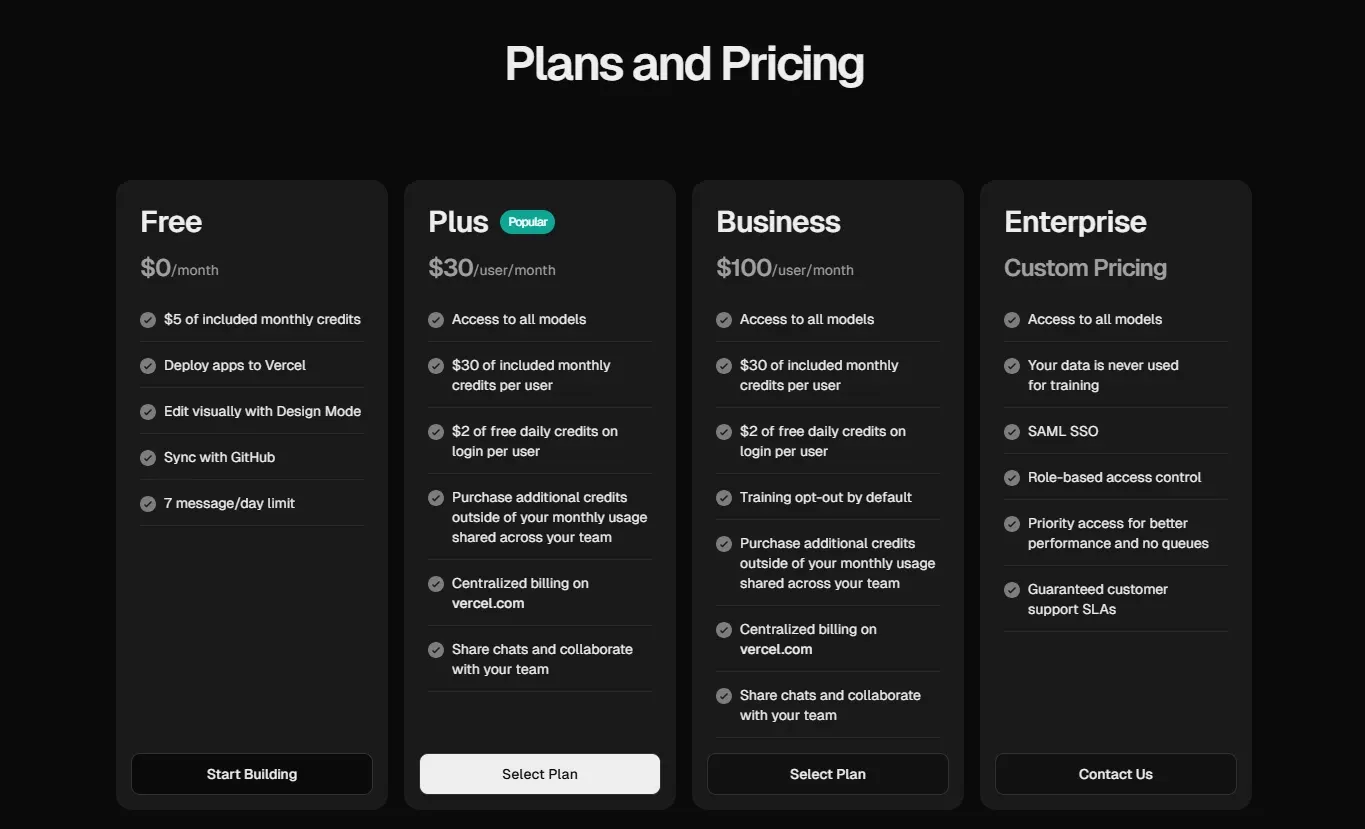
Free - $0/month
- $5 of included monthly credits.
- Hard cap of 7 messages per day.
- Includes Deploy to Vercel, Design Mode and GitHub sync.
- Figma import is not included - it requires a paid plan.
Plus - $30/user/month
- $30 of included monthly credits per user, plus $2 of free daily credits on login per user.
- Access to all models, team collaboration, shared projects, credit pooling and centralised billing.
- This is the tier where team features begin.
Business - $100/user/month
- The same credit allowance as Plus: $30 of included monthly credits per user plus $2 daily login credits.
- The differentiator is Training opt-out by default. You are paying the additional $70/user/month primarily for that data-handling guarantee, not for extra generation capacity - a distinction worth making explicit in a budget request.
Enterprise - Custom pricing
- SAML SSO, role-based access control, priority performance access and guaranteed support SLAs.
- “Your data is never used for training.”
Credit expiry rules - read these before budgeting
- Monthly included credits roll over to the next billing cycle and expire after 65 days.
- Purchased credits expire one year after purchase, and remain usable while the subscription stays active.
- Shared Credit Pool credits on Plus, Business and Enterprise also expire one year after purchase.
A note on the Premium plan
A Premium plan at $20/month with $20 of included monthly credits still appears in v0’s pricing documentation, but the docs state it “is in the process of being sunsetted and is no longer available to new users.” Teams evaluating v0 today should plan around Free, Plus, Business and Enterprise.
Who Should Use v0 - and Who Should Not
Strong fit: teams already deploying on Vercel with Next.js and shadcn/ui; design-to-code workflows anchored in Figma; product and marketing teams who need to ship real pages through a pull-request gate rather than filing tickets; engineering groups that want an agent operating inside their own repository rather than in a separate silo.
Poor fit: teams on non-JavaScript stacks, where the Next.js/React/Tailwind default works against you; organisations that need default training opt-out but cannot justify $100/user/month; workflows that depend on heavy mobile-viewport visual editing, which Design Mode does not support.
Head-to-Head Comparisons
- v0 vs Lovable: both generate full-stack applications from prompts. v0 is anchored to the Vercel and Next.js ecosystem with repository-first GitHub semantics and Figma import; Lovable targets a broader self-contained build-and-host workflow. See our full Lovable vs v0 breakdown.
- v0 vs Replit: Replit is a general-purpose cloud IDE with an agent layered on top and broad language support; v0 is opinionated about the Next.js/React/Tailwind/shadcn stack and optimises for shipping to Vercel production.
- v0 vs CodeRabbit: complementary rather than competing. v0 authors the pull request; CodeRabbit reviews it. Because v0 commits every message to a branch and merges through a PR, running CodeRabbit on those pull requests is a natural pairing.
Pricing, plan names, feature availability and all quoted figures in this review were verified against Vercel’s official pricing page, the v0 product documentation and Vercel changelog entries on 14 August 2026. Benchmark percentages are vendor-published figures from Vercel’s 1 June 2025 model announcement and are labelled as such. Plans and credit rules change - confirm current terms at v0.app before purchasing.
Evaluation Metrics
Accuracy in parsing call graphs, types, and catching subtle edge cases without noise.
Average execution time under 45s across PR triggers on GitHub Actions & GitLab CI.
Detection rate of OWASP Top 10 flaws, SQL injection risks, and leaked API secrets.
Time saved per senior reviewer and ease of interactive inline PR code chat.
Pros & Cons
What We Like (Pros)
- Sandbox runtime imports any GitHub repository and pulls environment variables straight from Vercel, so generated code lands in your own repo
- Design Mode edits typography, spacing, borders and shadows visually, then writes the changes back into source code
- Agentic loop runs web search, browser inspection, terminal commands and automatic error fixing without leaving the chat
- Figma import reads pages, frames, design tokens, layout and assets from a linked file on paid plans
Considerations (Cons)
- Free plan is capped at 7 messages per day and $5 of included monthly credits
- Training opt-out only becomes the default from the Business plan ($100/user/month) upward
- Design Mode is unavailable on read-only chats and on mobile viewports
- A connected GitHub repository becomes the single source of truth, so deleting it upstream puts the project code at risk
v0 by Vercel vs the Closest Alternatives
Alternatives named in this review, not tools that merely share a category.
| Feature Matrix |  v0 by Vercel Reviewed Tool |  Lovable |  Replit |
|---|---|---|---|
| Rating Score | 4.8 / 5.0 | 4.8 / 5.0 | 4.9 / 5.0 |
| Pricing Model | Free ($5 credits/mo) • Plus $30/user/mo • Business $100/user/mo | Free (30 credits/mo) • Pro from $25/mo • Business from $50/mo | Free Starter • Core $20/mo • Pro $100/mo |
| Best For | Teams already deploying on Vercel with Next.js and shadcn/ui; design-to-code workflows anchored in Figma. | Non-technical founders validating an idea; internal dashboards and tools that would otherwise sit in an IT backlog. | Developers who want a full Linux container with root shell access from any browser, with no local toolchain to install; learners and quick experiments, covered by the free Starter tier. |
| Key Differentiator | Prompt or Figma to Next.js and shadcn/ui, deployable straight to Vercel | Generates full-stack applications around Supabase from natural-language prompts | Full Linux container with root shell and 50+ languages, in the browser |
| Action / Review | Try Free | Read Review | Read Review |
Full breakdown: v0 by Vercel vs Lovable.
Frequently Asked Questions
Does v0 by Vercel train AI models on my code and prompts?
By default, free and Plus plans may use prompts and generated code to improve Vercel models. Training opt-out is enabled by default on the Business plan ($100 per user per month) and Enterprise tier. Platform services hosting data remains strictly excluded from model training across all tiers.
How does v0 integrate with existing GitHub repositories?
v0 connects directly to your GitHub repository, treating it as the single source of truth. Every chat session operates on a dedicated branch (such as v0/branch-name), committing changes after each message. Merging into base branches runs through standard pull requests, maintaining your existing CI/CD review workflows.
Can I import Figma design files directly into v0?
Yes. Figma import is available on paid plans. You can paste a Figma file or frame link directly into the prompt. v0 inspects design tokens, auto layout, typography, colors, and assets, automatically translating them into production Next.js and shadcn/ui component code.
What programming languages and frameworks does v0 support best?
v0 is heavily optimized for the modern TypeScript and JavaScript ecosystem, specifically Next.js 15, React, Tailwind CSS, and shadcn/ui. It also supports Python and SQL for data analysis applications with Matplotlib, Pandas, and integrations with Supabase, Neon, Upstash, and Snowflake.
What is the difference between v0 Free, Plus, and Business plans?
The Free plan provides $5 in monthly credits with a 7-message daily limit. The Plus plan ($30 per user per month) includes $30 monthly credits, $2 daily login credits, all models, and Figma import. The Business plan ($100 per user per month) adds default model training opt-out protection.
Who owns the code generated by v0?
You own all code generated by v0. Vercel does not claim intellectual property rights over output generated from your prompts. Because generated components may resemble existing patterns, teams should maintain standard code review and automated testing gates before deploying to production.


