

The Bottom Line
Zernio is ranked #8 in our Business & Productivity category. One API and MCP server for posting and analytics across 16 social platforms. We rate it 4.7/5.
Best for
SaaS products that need to offer social posting to their own customers; teams building AI agents that operate social channels.
Considerations
Marketers who want a calendar interface, where Buffer or Later remain the right answer; anyone managing one or two accounts by hand, who is already covered by the free tier and does not need an API at all.
Executive Summary & Independent Verdict
Zernio is routinely miscategorised, including by software directories, as a social media management application. It is not one.
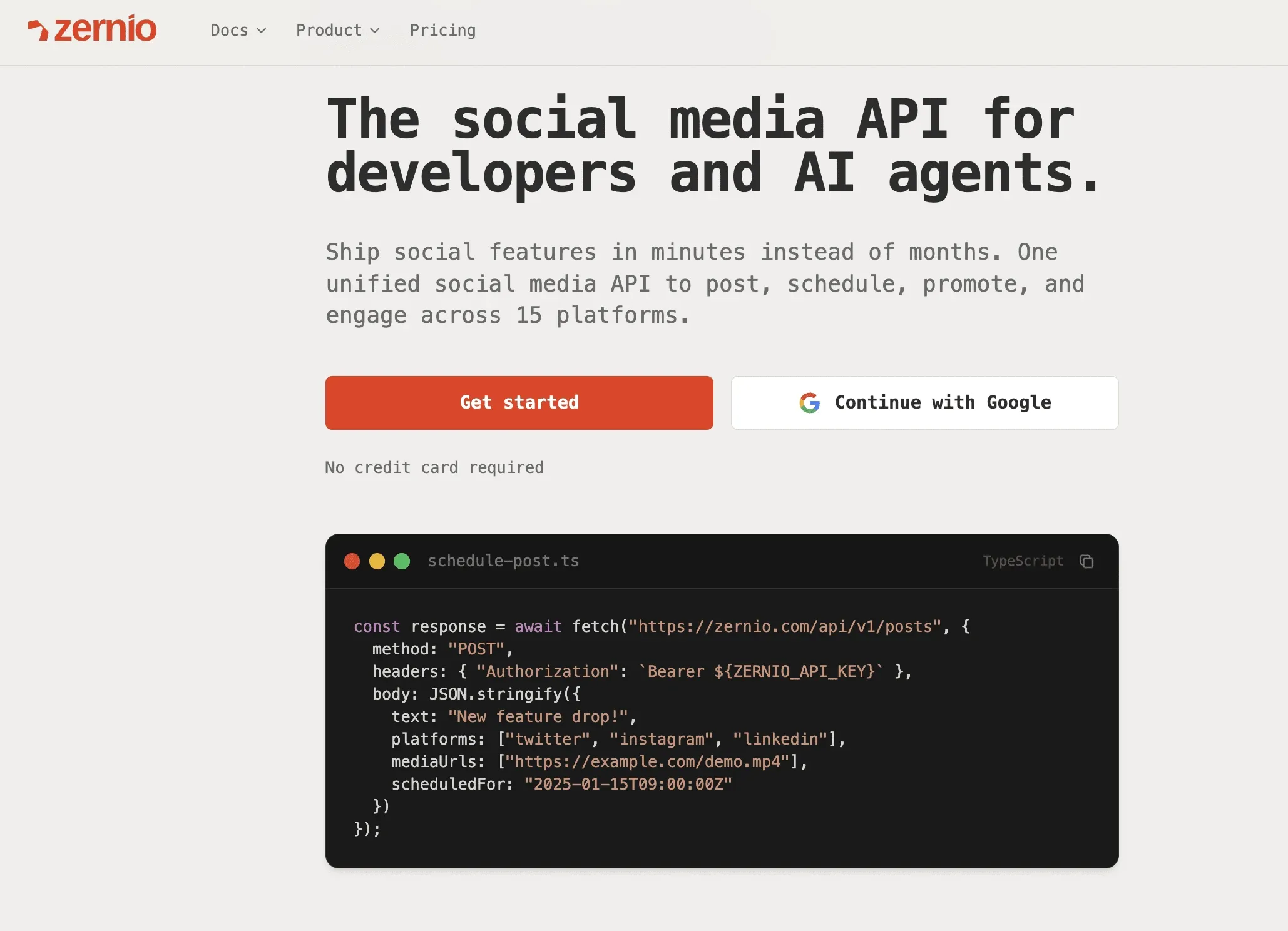
In its own description it is “a developer-first REST API and hosted MCP server that lets apps and AI agents post, schedule, and analyze content across 16 social platforms plus 7 ad networks.” There is no scheduling calendar for a marketer to drag posts around. There is an API key, an endpoint, and - in 2026 the more interesting half - an MCP server that lets an AI agent do the work directly.
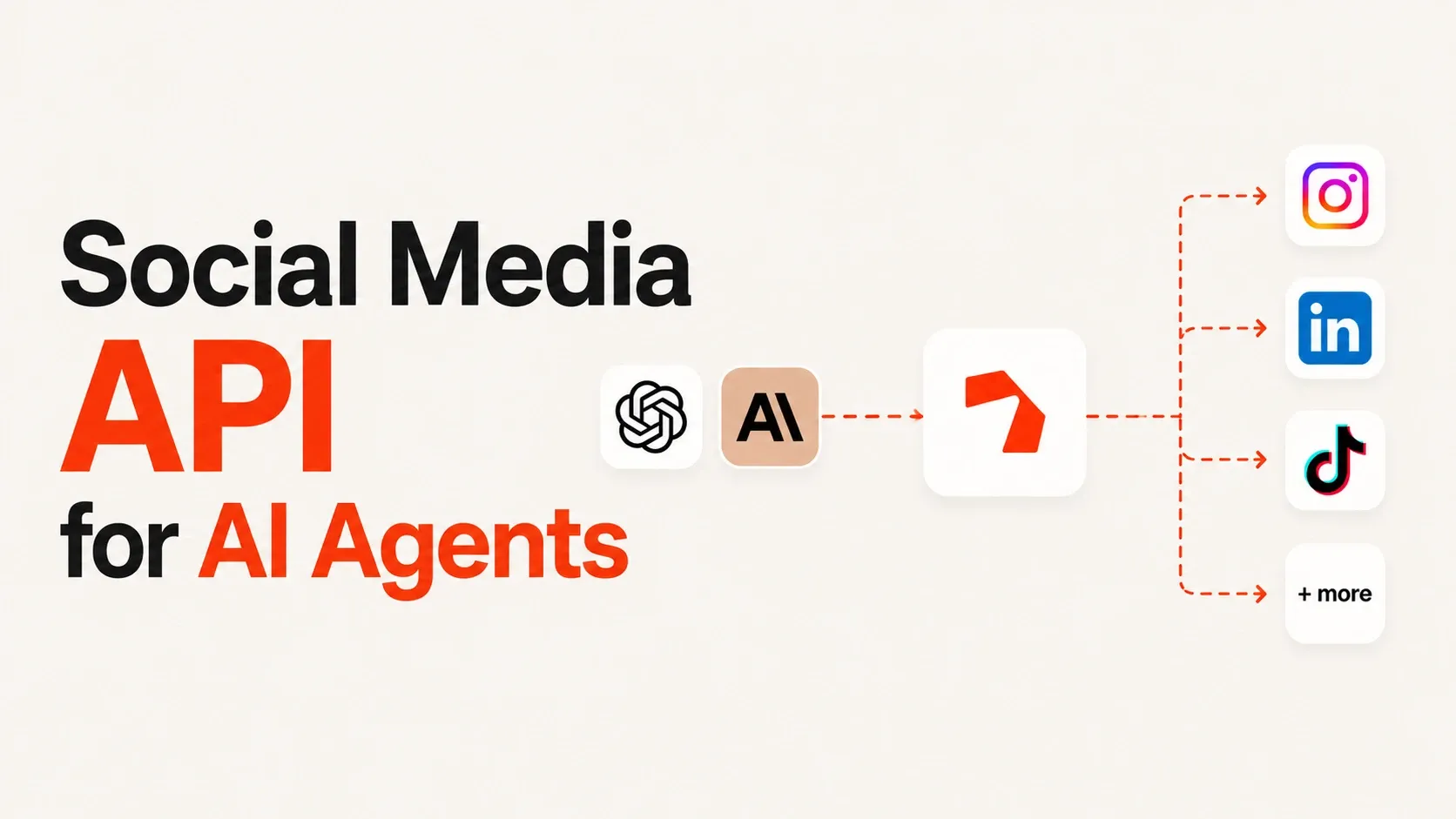
Its real competitor is therefore not Buffer or Hootsuite. It is the decision to build the integrations yourself: sixteen developer applications, sixteen approval processes, sixteen OAuth implementations and sixteen sets of rate-limit rules to maintain indefinitely.
We place Zernio at #8 in Business & Productivity. That ranking reflects how narrow the audience is rather than any weakness in execution. For the developers it targets it is excellent; for everyone else it is the wrong tool entirely, and the most useful thing this review can do is help you work out which group you are in quickly.
What Zernio Replaces: Sixteen Integrations You Do Not Have to Build
The problem, stated honestly
Adding “post to social” to a product sounds like a small feature and is not.
Each platform requires its own developer application, its own review process - which can take weeks and can be rejected - its own OAuth flow, its own media format rules and its own rate limits. All of those change without asking you, and several of them have changed materially in the past two years.
The initial build is measured in weeks. The maintenance never ends, and it is the kind of maintenance that produces no visible product improvement, which makes it perpetually difficult to prioritise.
What Zernio absorbs
Zernio handles authentication, media formatting, rate limits and platform-specific requirements, plus automatic token refresh and webhook notifications.
The most consequential line is this one: “No platform developer apps or OAuth setup required on your end.” You are not registering sixteen applications, because Zernio already did, and you are not waiting on sixteen review processes before you can ship.
The documentation claims most developers ship their first post in under five minutes - sign up, generate an API key, make a single POST request. That figure is a vendor claim and we have not timed it independently, but the architecture is consistent with it: there is no per-platform onboarding to complete.
The four API surfaces
- Posting API - publish and schedule
- Comments API - read and reply to comments
- Messaging API - direct messages
- Analytics API - engagement, reach and follower metrics per post and per account
The Comments and Messaging APIs are what distinguish this from a publishing tool. Reading and replying programmatically is what makes automated community management possible at all, and it is the half of social operations that most publishing-focused tools ignore entirely.
The MCP Server: Built for Agents, Not Dashboards
This is the part of Zernio that is genuinely of the moment, and the part almost no coverage discusses.
Zernio ships a hosted MCP server exposing more than 280 tools, compatible with Claude Desktop, Cursor and any MCP-compatible client. The same capabilities available over REST are available as tools an AI agent can call directly.
Why that matters
Without MCP, connecting an agent to a social platform means writing a glue layer: tool definitions, authentication handling, response parsing, error handling, and a maintenance burden that grows with every platform change. With a hosted MCP server, the agent connects and the capability is simply present.
A realistic pattern this enables: an agent monitors brand mentions across platforms, drafts contextual replies, holds them for human approval, and posts the approved ones - with no bespoke integration code between the model and sixteen social networks. The human stays in the loop for judgement; the agent handles the mechanics.
The sceptical view
More than 280 tools is a very large surface to expose to a model, and it is worth saying so plainly rather than treating the number as an unqualified selling point.
Tool selection accuracy tends to degrade as the number of available tools grows, and a large tool manifest consumes context before any work begins. An agent that spends a meaningful share of its reasoning budget deciding which of 280 tools to call is a worse agent than one with twelve well-chosen ones.
Whether Zernio’s server is organised well enough to stay usable at that scale - namespaced sensibly, scoped per platform, filterable so a client can load only what it needs - is the thing to test during evaluation rather than assume. It is the single most important question to answer if the MCP capability is why you are buying.
Decoding the Graduated Pricing
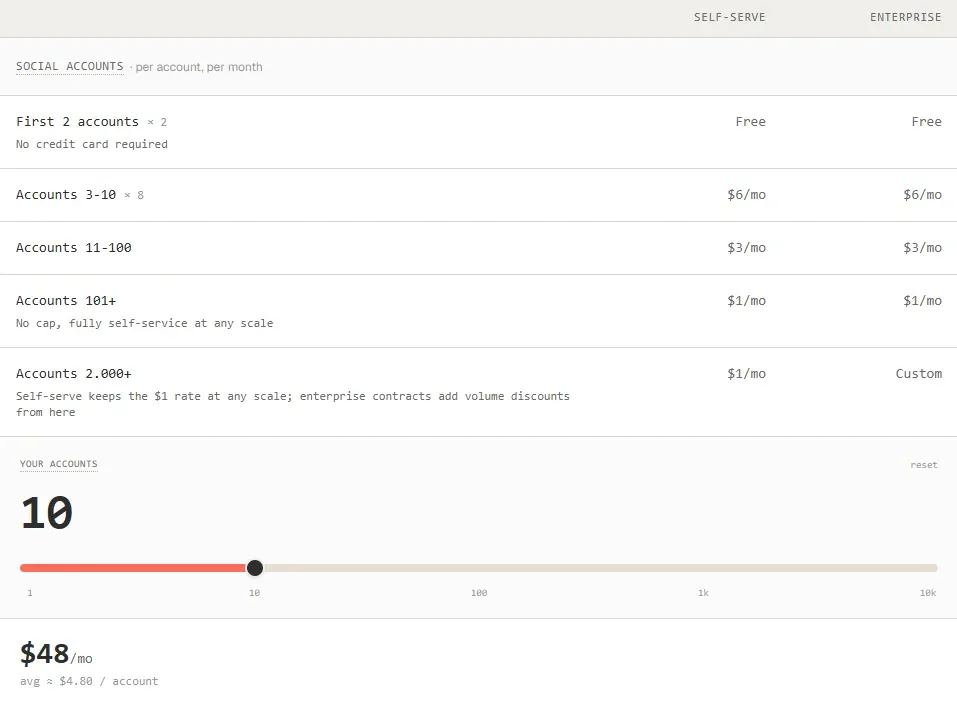
Zernio bills per connected social account, and the model is graduated - a distinction that most published figures about it get wrong, including several tool directories.
In Zernio’s own words: “each account is billed at its own tier band’s rate, not one flat tier.”
| Account range | Rate per month |
|---|---|
| 1 to 2 | Free forever, no credit card required |
| 3 to 10 | $6 per account |
| 11 to 100 | $3 per account |
| 101 to 2,000 | $1 per account |
| 2,001 and above | $1 per account, no cap |
The worked example
Zernio’s own documentation gives this: 20 accounts cost $6 x 8 + $3 x 10 = $78 per month.
Accounts one and two are free. Accounts three through ten - eight accounts - bill at $6. Accounts eleven through twenty - ten accounts - bill at $3.
Compare that with the two ways it is commonly misread. Flat $6 across twenty accounts would be $120. Flat $3 would be $60. The correct answer is $78, and neither shortcut produces it. If you have read a figure for Zernio elsewhere, check which method produced it before relying on it.
Cost at scale
Our own arithmetic, applying the bands above:
| Accounts | Calculation | Monthly cost | Effective per account |
|---|---|---|---|
| 10 | $6 x 8 | $48 | $4.80 |
| 20 | $6 x 8 plus $3 x 10 | $78 | $3.90 |
| 50 | $6 x 8 plus $3 x 40 | $168 | $3.36 |
| 100 | $6 x 8 plus $3 x 90 | $318 | $3.18 |
| 500 | $6 x 8 plus $3 x 90 plus $1 x 400 | $718 | $1.44 |
| 1,000 | $6 x 8 plus $3 x 90 plus $1 x 900 | $1,218 | $1.22 |
The effective per-account cost falls from $4.80 to $1.22 across that range. The curve is built for platforms managing accounts on behalf of many end customers - an agency, or a SaaS product offering social publishing to its own users - rather than for a single brand managing its own presence.
No feature tiers at all
Every connected account - including the two free ones - provides “full API access, unlimited posts, all 14 platforms, Analytics, Inbox, and Ads”, with no profile limits, no post caps and no per-feature add-ons.
This is unusual and worth stating plainly: there is no upsell. You are not evaluating a reduced version. Two accounts, free, forever, with the complete product - which makes the evaluation path unusually low-friction, since you can build a full integration and only start paying when you connect a third account.
Note: one inconsistency to flag. The marketing site describes 16 platforms while the pricing documentation says “all 14 platforms”. We have reproduced both figures as published rather than picking one. Confirm the current list against the platform documentation if a specific network matters to your use case.
The Costs That Are Not in the Headline Price
Usage-based pricing rewards close reading. Four charges sit outside the per-account rate.
X and Twitter operations are pass-through. They bill at exactly X’s own rates, $0.005 to $0.200 per operation. X is the only platform that charges separately, a consequence of its API pricing rather than a Zernio margin.
If your workload is X-heavy, model this explicitly. At the top of that range, high-volume operations add up quickly: 10,000 operations at $0.200 is $2,000, which dwarfs the account fee entirely. Our own arithmetic - but the arithmetic is the point, because the headline pricing gives no hint of it.
Managed Ads - the first 500 are free, then $0.01 per active ad per month.
Phone Numbers - $3 to $21 per month, varying by country.
Calls, SMS and WhatsApp - per-minute or per-message rates.
On the positive side, billing accrues automatically with daily proration, and “every invoice is itemized” down to specific accounts, numbers and operations. For anyone who has tried to reconcile an opaque platform bill against internal usage, that itemisation has real operational value - you can attribute cost to the customer who generated it, which is essential if you are reselling the capability.
There is also no enterprise contract required to scale. The published rates run all the way up, which removes the usual point at which usage-based pricing becomes a negotiation.
Ads Across Seven Networks
Unified ad campaigns span Meta, Google, TikTok, LinkedIn, Pinterest, X and OpenAI Ads.
OpenAI Ads in that list is the detail worth pausing on. Very few platforms support it, and its presence is a reasonable signal that Zernio adds networks quickly rather than treating its integration list as finished - which for infrastructure you are building on is a more useful signal than the current count.
Who Should Use Zernio, and Who Should Not
Strong fit: SaaS products that need to offer social posting to their own customers; teams building AI agents that operate social channels; agencies automating publishing across many client accounts, where the graduated pricing works strongly in their favour; anyone who needs to read and reply to comments and direct messages programmatically.
Poor fit: marketers who want a calendar interface, where Buffer or Later remain the right answer; anyone managing one or two accounts by hand, who is already covered by the free tier and does not need an API at all; teams without engineering capacity to integrate it; workloads dominated by X operations, where the pass-through cost may exceed the platform fee several times over.
Head-to-Head Comparisons
- Zernio vs Buffer or Hootsuite: different categories. Those are applications for people; Zernio is infrastructure for software. If a human will be clicking the interface, you want one of those instead.
- Zernio vs building it yourself: the comparison that actually matters. Sixteen integrations, sixteen approval processes and perpetual maintenance, against $78 per month for twenty accounts. For most teams the engineering cost of the first month alone exceeds a year of Zernio, and the maintenance never appears on the build estimate.
- Zernio vs Dub.co: the same architectural pattern in an adjacent domain. Dub is developer-first infrastructure for links and partner programmes, also with an MCP server. Both are examples of marketing infrastructure being sold as an API rather than a dashboard.
- Zernio vs Bright Data: both are data infrastructure, approached from opposite directions. Bright Data collects public web data without official access; Zernio operates through official platform integrations. Where an official API exists, Zernio’s approach is the more sustainable one.
Product description, platform coverage, pricing bands, the twenty-account worked example and additional usage charges in this review were verified against Zernio’s official site and pricing documentation on 17 August 2026. The cost-at-scale table and X pass-through modelling are our own arithmetic applying Zernio’s published rates. The discrepancy between 16 and 14 platforms is reproduced as published on the two respective pages. At least one prominent Zernio comparison online is published by a direct competitor. Confirm current terms at zernio.com.
Evaluation Metrics
Accuracy in parsing call graphs, types, and catching subtle edge cases without noise.
Average execution time under 45s across PR triggers on GitHub Actions & GitLab CI.
Detection rate of OWASP Top 10 flaws, SQL injection risks, and leaked API secrets.
Time saved per senior reviewer and ease of interactive inline PR code chat.
Pros & Cons
What We Like (Pros)
- The first two connected accounts are free forever with no credit card required
- Every account includes full API access, unlimited posts, analytics, inbox and ads with no feature tiers
- Hosted MCP server exposes over 280 tools to Claude Desktop, Cursor and other MCP clients
- Handles OAuth, token refresh, rate limits and media formatting for every platform
Considerations (Cons)
- X and Twitter operations are billed as pass-through on top of the account price
- It is an API, not a dashboard, so non-technical marketers cannot use it directly
- Managed ads beyond the first 500 add $0.01 per active ad per month
- Graduated pricing is easy to misread, and published third-party figures often get it wrong
Zernio vs the Closest Alternatives
Alternatives named in this review, not tools that merely share a category.
| Feature Matrix |  Zernio Reviewed Tool | Buffer / Hootsuite Not reviewed here |
|---|---|---|
| Rating Score | 4.7 / 5.0 | Not rated by us |
| Pricing Model | 2 accounts free • $6/account (3-10) • $3/account (11-100) • $1/account (101+) | Buffer from $5/channel/mo - Hootsuite from $99/mo |
| Best For | SaaS products that need to offer social posting to their own customers; teams building AI agents that operate social channels. | Marketers who want a posting calendar and a human interface |
| Key Differentiator | One REST API and MCP server covering 16 social platforms and 7 ad networks | Applications for people to click, not infrastructure for software |
| Action / Review | Try Free |
Frequently Asked Questions
Does Zernio train AI models on private repository code?
No. Zernio strictly adheres to zero-data-retention standards. Code diffs and repository context are processed in ephemeral memory for the duration of the review execution and are never stored or used to train public models.
How do I configure custom coding standards and linters?
Zernio reads a repository configuration file placed in the root directory. You can define rule severity, exclude specific paths, set language guidelines, and prompt instructions matching your team's style guide.
Is Zernio free for open-source software projects?
Public open-source repositories hosted on GitHub and GitLab receive free automated reviews with no cap on the number of repositories, pull requests, or contributors.
Which languages and frameworks does Zernio support?
Zernio covers the mainstream ecosystem - TypeScript/JavaScript, Python, Go, Java, Ruby, PHP, Rust, and C# - along with infrastructure-as-code formats such as Terraform, Dockerfiles, and Kubernetes manifests.
How does Zernio handle security scanning?
Zernio scans every incoming commit for hardcoded API keys, database credentials, SQL injection risks, and OWASP Top 10 security vulnerabilities before code is merged into production. High-priority security alerts are flagged directly inline within the pull request.


