

The Bottom Line
AI Fiesta is ranked #2 in our Business & Productivity category. Nine premium AI models in one chat window for $12 a month. We rate it 4.9/5.
Best for
Teams already paying for two or more AI subscriptions without using each one's exclusive features; anyone who wants several perspectives on a decision that matters.
Considerations
Heavy premium-model use, where the 4x multiplier cuts the effective allowance to 750,000 tokens; anyone who depends on product-level features such as Deep Research, Canvas or custom GPTs, which API access does not include.
Executive Summary & Independent Verdict
AI Fiesta is not another AI model. It is an access layer that sits in front of nine of them, and its entire proposition is arithmetic: “Stop juggling tabs and subscriptions - AI Fiesta gives you access to all best-in-class AI models for just $12/month.”
That number is real, and it is genuinely low. The question this review answers is what $12 buys, and where the boundaries of that offer sit - because the pricing page publishes two facts that most coverage of this product reads past.
The first is that the 3 million token allowance is not a flat pool: premium models draw on it at 4x. The second is that access to a model through an API is not the same product as the subscription the vendor sells around it. Neither fact is hidden - both are printed on the pricing page - but neither survives into the headline.
We place AI Fiesta at #2 in Business & Productivity. It earns that on scope and price: nothing else in this category puts nine frontier models behind a single $12 charge, and the comparison workflow it enables is a genuinely better way to work than trusting one model by default. It is not #1 because the pricing model quietly penalises the exact behaviour the product is sold on.
What You Actually Get for $12
The nine models
AI Fiesta’s own FAQ names them: “Grok 4, ChatGPT 5, Gemini 2.5 Pro, DeepSeek, Claude Sonnet 4, Perplexity Sonar Pro, Kimi K2, Qwen 3 Max and Mistral”. The homepage summarises this as “One Window. 9+ Perspectives.”
You will see larger numbers quoted elsewhere. Those counts include lightweight variants - the mini, nano and flash tiers that each provider ships alongside its flagship. Counting them is not dishonest, but it inflates a figure that matters less than it appears: what you are buying is nine distinct points of view, not sixteen meaningfully different ones.
Models can be toggled on and off during a conversation. The FAQ is specific that you can “turn them back on later without losing your chat history”, which matters more than it sounds - it is the mechanism by which you control cost, as the next section explains.
Modes of working
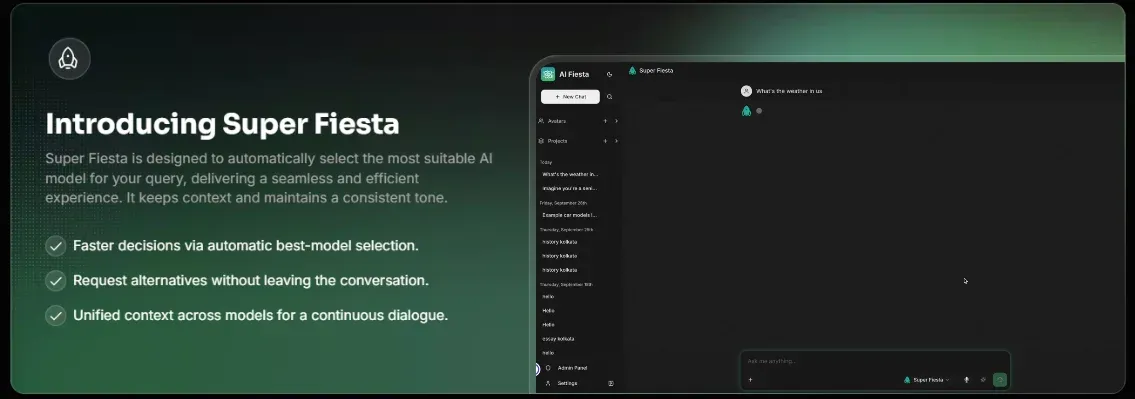
Super Fiesta picks a model for you. The site describes it as automatic best-model selection that “keeps context and maintains a consistent tone”, with the ability to “Request alternatives without leaving the conversation”. This is the mode for people who do not want to think about model selection at all.
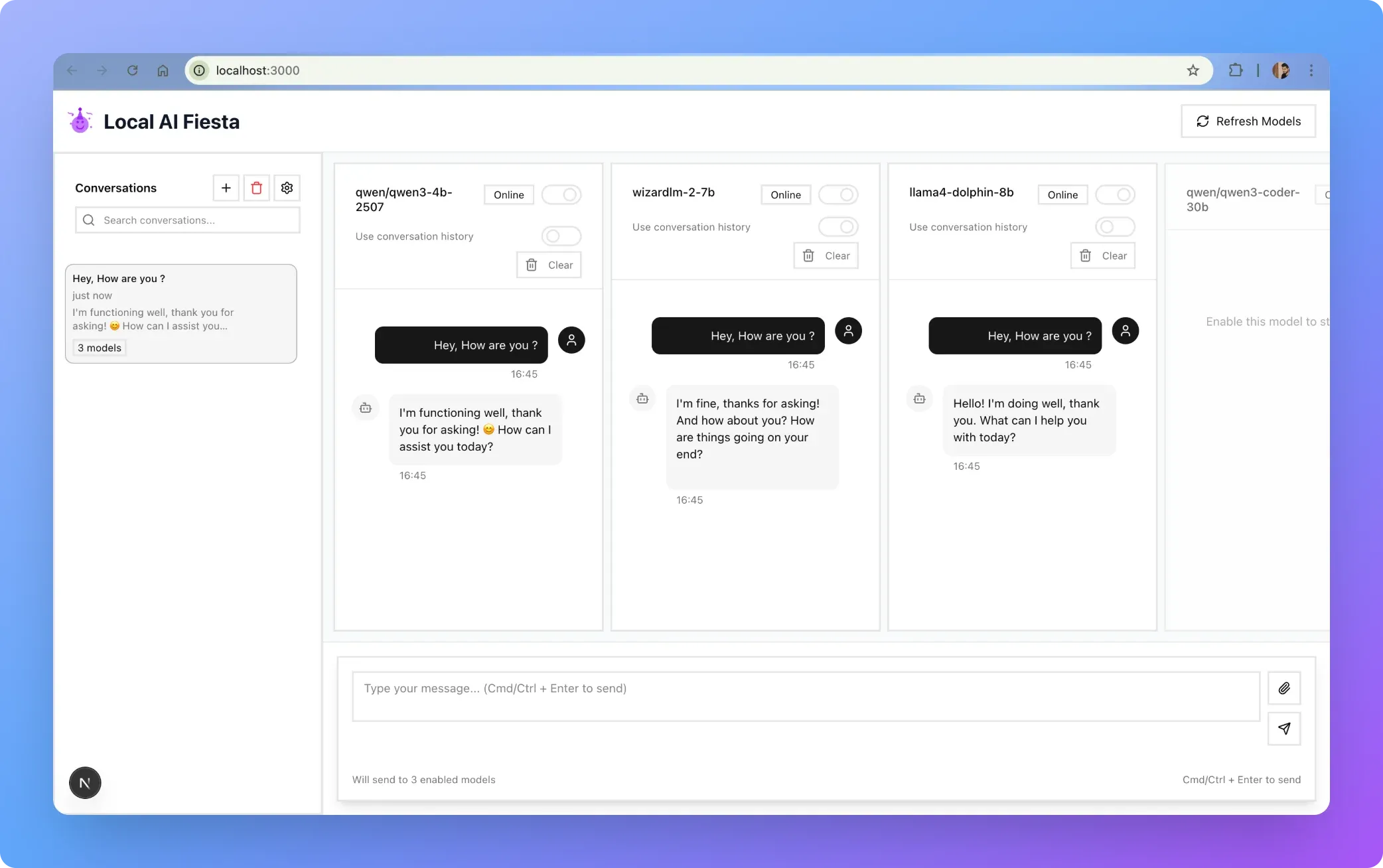
Alongside it, the platform supports working with one model at a time or fanning a prompt out across several for direct comparison - the mode the product is named for.
Everything else in the box
The plan card lists prompt enhancement, a memory feature, image generation, audio transcription, and add-ons described as “Avatars, Games and more”. Avatars lets you converse with historical figures or assemble a panel of expert personas. Custom Projects carries your own system instructions. Paid users also get Promptbook at a separate subdomain.
There is a lot here, and some of it is filler. Games - short exercises for focus and memory - is a curious inclusion in a productivity subscription. But image generation and transcription are real cost savings for anyone who would otherwise pay for those separately.
Decoding the Token Allowance
This is the section that should decide your purchase.
The FAQ states the terms plainly:
“You get 3,000,000 tokens per month with your subscription. Each token is approximately ¾ of a word. For most users, this is far more than needed - the average usage is around 200,000 tokens per month. Standard models consume tokens at 1x rate whereas Premium models consume tokens at 4x rate.”
Read the last sentence again. Three million is the number at the standard rate. Here is what it becomes in practice.
The multiplier
Our own arithmetic, using the vendor’s published rates:
| How you work | Calculation | Effective allowance |
|---|---|---|
| Standard models only | 3,000,000 ÷ 1 | 3,000,000 tokens |
| Premium models only | 3,000,000 ÷ 4 | 750,000 tokens |
| Premium, expressed in words | 750,000 × ¾ | ~562,500 words, input and output combined |
A 562,500-word budget still sounds generous. It is roughly six full-length novels. But that figure assumes you are talking to one model at a time - which is not what you bought this for.
The fan-out problem
Side-by-side comparison sends the same prompt to every enabled model, and every model is charged separately. The feature that justifies the subscription is also the feature that spends it fastest.
Our own arithmetic, assuming a question and its answer together run to roughly 1,000 tokens, with six premium models enabled:
- 6 models × 1,000 tokens × 4x = 24,000 tokens for one question
- 3,000,000 ÷ 24,000 = about 125 comparisons per month, or roughly four per day
That is the honest shape of the product. Four multi-model comparisons a day is plenty for someone using this on decisions that matter. It is not plenty for someone who intended to run every query through six models all day long.
The lever is the toggle. Leave two models enabled for routine work and six for the questions that deserve it, and the allowance stops being a constraint. Leave all nine on by default and it becomes one.
What the vendor says about typical use
AI Fiesta states that average usage is around 200,000 tokens per month and that “3 million tokens is a very large allowance, and 99% of users never come close to exhausting it”, with warnings before you reach zero.
Both things can be true. If the average user is running one or two models on short prompts, the allowance is enormous. Our arithmetic above is not a contradiction of that claim - it is a description of what happens at the other end of the distribution, where the people most attracted to a multi-model tool tend to live.
One further detail worth stating because the pricing page does not: the meter counts input as well as output. Upload a long document with six models enabled and that document is charged six times before a single word comes back.
Access to Models Is Not Access to Products
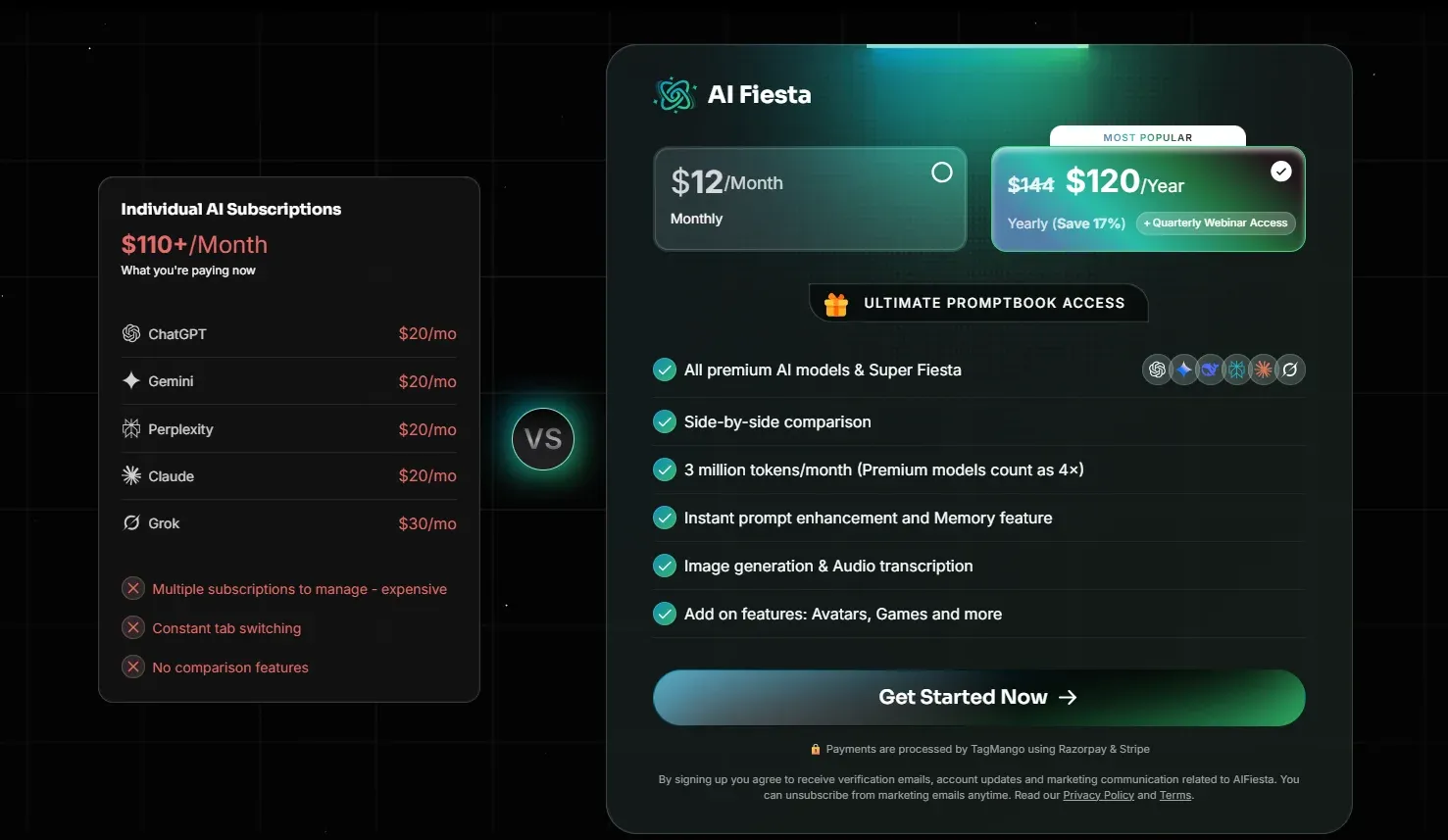
The homepage sets AI Fiesta against a column headed “Individual AI Subscriptions - $110+/Month”, itemised as ChatGPT $20, Gemini $20, Perplexity $20, Claude $20 and Grok $30.
The addition is correct. The comparison is not quite like for like, and this is the second thing a buyer should understand before subscribing.
Those five subscriptions do not sell model access. They sell applications built on top of the models - and the surrounding product is where a large share of the value sits. Working through an API, you get the model’s reasoning without the workspace: no Deep Research, no Canvas, no Projects or custom GPTs, no Artifacts, no first-party connectors. Those are product features, not model capabilities, and an aggregator cannot pass them through.
This is not a flaw in AI Fiesta. It is the structural trade-off of every aggregator, and the honest way to frame it is as a different purchase rather than a cheaper version of the same one:
- Five subscriptions buy depth in five separate workspaces you must switch between.
- AI Fiesta buys breadth in one workspace, at roughly a tenth of the price, minus the workspaces.
If the features you actually use daily are the product features, the $110 column is not really $110 of substitutable value and the saving is smaller than it looks. If what you use is the model’s answer to a question, the saving is close to the full amount.
The Comparison Workflow, and Why It Works
Strip away the pricing and there is a real idea here, one worth stating on its own terms.
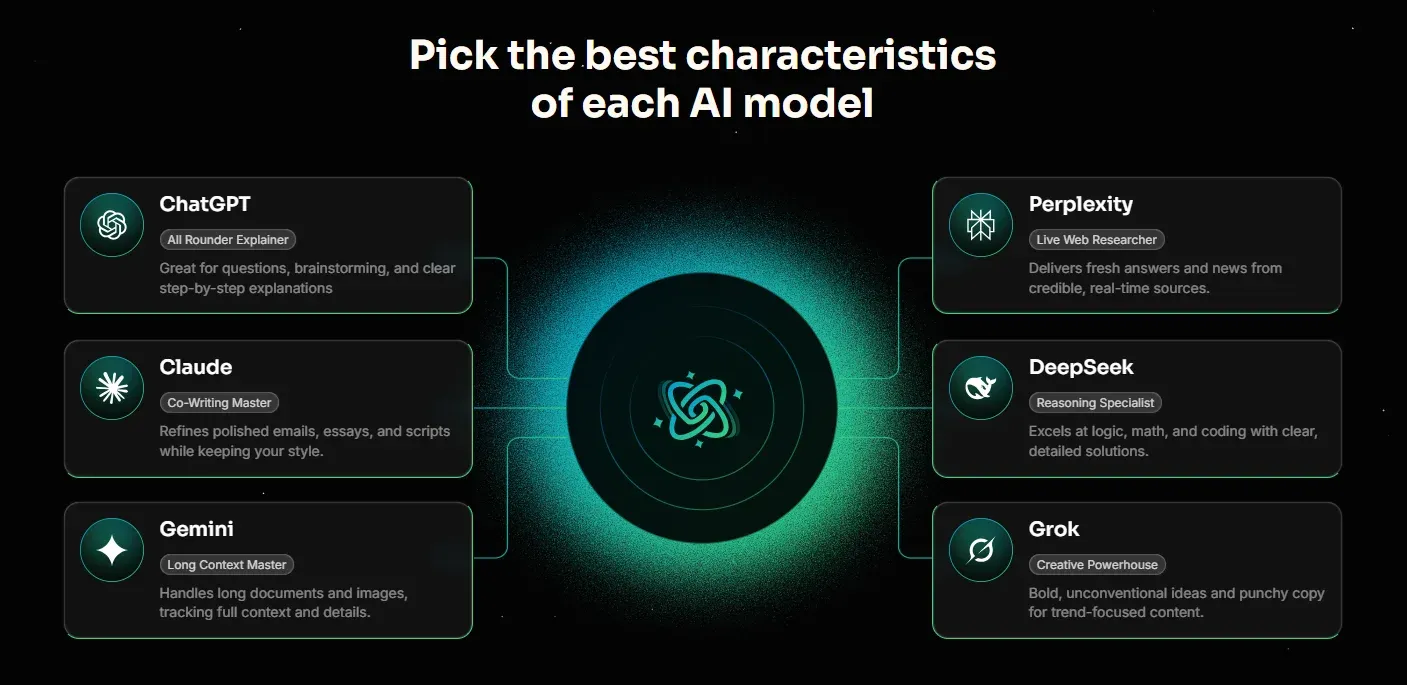
The industry frames model choice as a league table: which one scores highest, writes the best code, reasons most reliably. Those comparisons are useful and incomplete. A model tuned for long-horizon reasoning is not automatically the one you want for a marketing headline. The more capable these systems become, the more the useful question shifts from which is best to which fits this task.
And sometimes the best answer does not come from one model at all. It comes from noticing where several disagree.
A working method
- Ask the same question. Keep the wording identical across models unless you are deliberately testing prompt differences.
- Compare conclusions before prose. Where do they agree? Where do they diverge? What assumptions differ?
- Investigate the outlier. An answer that stands apart is not automatically wrong. Sometimes it holds the most useful insight; sometimes it exposes an error. Either way it is the most informative response on the screen.
- Verify what matters. For claims with consequences, check primary sources. Comparison improves your process; it does not remove the need to confirm.
- Synthesise yourself. Treat the models as research assistants, not as the decision.
The disagreement is the product. Consensus tells you the ground is firm. Divergence tells you your own understanding is incomplete - which is precisely the information a single confident answer will never give you.
Why this matters more as models improve
When AI was visibly unreliable, people checked its work. As answers become more fluent and better formatted, the risk inverts: polish invites trust. A well-structured wrong answer is more dangerous than an obviously bad one.
Multiple perspectives reintroduce friction where friction is useful. That is the strongest argument for this category of tool, and it holds regardless of which aggregator you choose.
AI Fiesta does put a marketing claim behind this on its homepage - that among six answers to a sample question, three were incomplete and one was wrong. No methodology accompanies that figure, so we would not present it as evidence. The underlying argument stands on its own without it.
Pricing Analysis
| Plan | Price | Notes |
|---|---|---|
| Monthly | $12/month | Full feature set |
| Yearly | $120/year, listed against a struck-through $144 | Marked “Save 17%”; adds Quarterly Webinar Access |
Our own arithmetic: the annual plan works out to $10 per month, saving $24 a year against monthly billing. The vendor’s “17%” is accurate. That is a small enough gap that annual billing is worth taking only once you know the tool suits you - there is no meaningful penalty for testing a month first.
Payments are handled by TagMango through Razorpay and Stripe, which is worth knowing if your finance process cares who appears on the statement.
Where the break-even sits
The subscription pays for itself the moment it replaces two paid AI subscriptions, provided you were not relying on those products’ exclusive features. Against one subscription, the maths is closer than the marketing suggests: you are trading a full workspace for breadth of models.
Against no subscription at all, $12 is the cheapest route to nine frontier models we are aware of - and that, more than any feature, is the reason this product exists.
Who Should Use AI Fiesta, and Who Should Not
Strong fit: anyone already paying for two or more AI subscriptions without using each product’s exclusive features; researchers, analysts and writers who benefit from several readings of the same question; teams who want to evaluate models against real work before standardising on one; users on tight budgets who need breadth more than depth; people who want image generation and transcription bundled rather than billed separately.
Poor fit: heavy users who work exclusively in premium models, where the 4x multiplier cuts the effective allowance to 750,000 tokens; anyone whose daily workflow depends on Deep Research, Canvas, Artifacts, Projects or custom GPTs, none of which come through an API; teams needing contractual support guarantees for sensitive work; users who want a dedicated research tool rather than a chat interface with search among its models.
Head-to-Head Comparisons
- AI Fiesta vs five individual subscriptions: the comparison the vendor invites, and the one most readers are actually weighing. Breadth of models in one window against depth of features in five. The $110 figure is arithmetically correct but assumes those five products are substitutable by API access, which they are not.
- AI Fiesta vs TypingMind: bundled versus bring-your-own-key. TypingMind sells a one-time licence and you pay each provider directly at cost, which suits uneven usage; AI Fiesta sells a flat monthly rate with a metered allowance, which suits predictable budgeting. The deciding question is whether you want to manage API keys.
- AI Fiesta vs Devs.ai: not competitors, despite surface similarity. Devs.ai governs how an organisation uses AI - policy, audit, contractual assurances. AI Fiesta gives an individual more perspectives. A company can sensibly run both, for different reasons.
Evaluation Metrics
Accuracy in parsing call graphs, types, and catching subtle edge cases without noise.
Average execution time under 45s across PR triggers on GitHub Actions & GitLab CI.
Detection rate of OWASP Top 10 flaws, SQL injection risks, and leaked API secrets.
Time saved per senior reviewer and ease of interactive inline PR code chat.
Pros & Cons
What We Like (Pros)
- Nine premium models named on the pricing page, in one interface for $12 per month
- Models can be toggled on and off mid-conversation without losing chat history
- New model versions are promised at no extra cost when providers release them
- Image generation, audio transcription and prompt enhancement are included rather than sold separately
Considerations (Cons)
- Premium models draw on the allowance at 4x, cutting 3 million tokens to an effective 750,000
- Side-by-side comparison multiplies token spend by the number of models left enabled
- API access does not include product features such as Deep Research, Canvas or custom GPTs
- The token meter covers input and output together, so long documents are charged twice over
AI Fiesta vs the Closest Alternatives
Alternatives named in this review, not tools that merely share a category.
| Feature Matrix |  AI Fiesta Reviewed Tool | Five individual subscriptions Not reviewed here | TypingMind Not reviewed here |
|---|---|---|---|
| Rating Score | 4.9 / 5.0 | Not rated by us | Not rated by us |
| Pricing Model | $12/mo • $120/yr (3M tokens, premium models count 4x) | $110/mo as itemised on AI Fiesta's own pricing page | One-time licence: Standard $39, Extended $79, Premium $198 |
| Best For | Teams already paying for two or more AI subscriptions without using each one's exclusive features; anyone who wants several perspectives on a decision that matters. | Anyone who depends on Deep Research, Canvas, Artifacts or custom GPTs | Technical users with existing API keys and uneven month-to-month usage |
| Key Differentiator | Fans a single prompt across nine premium models and shows the answers side by side | Full product features from each vendor rather than pooled model access | Bring-your-own-key interface; you pay each model provider directly at cost |
| Action / Review | Try Free |
Frequently Asked Questions
How long does 3 million tokens actually last?
It depends entirely on which models you enable. AI Fiesta bills standard models at 1x and premium models at 4x, so an allowance of 3 million tokens becomes an effective 750,000 if you work exclusively with premium models. The multiplier compounds with side-by-side comparison, because every enabled model is charged separately for the same prompt.
Is paying $12 for ChatGPT 5 the same as a ChatGPT Plus subscription?
No. AI Fiesta routes prompts through each provider's API, which gives you the model but not the product built around it. Features such as Deep Research, Canvas, Projects and custom GPTs belong to the first-party applications and are not part of API access.
Which models are included?
The pricing page names nine: Grok 4, ChatGPT 5, Gemini 2.5 Pro, DeepSeek, Claude Sonnet 4, Perplexity Sonar Pro, Kimi K2, Qwen 3 Max and Mistral. The site describes this as 9+ perspectives.
Do I pay extra when a provider releases a newer model?
AI Fiesta states that if a provider launches a higher version you get access at no extra cost. The site does not specify how quickly a new release is added.
Does the token allowance count what I type as well as what the models answer?
Yes. The allowance covers input and output together, which matters most when you upload long documents, because the same text is sent to every model you have enabled.


