

The Bottom Line
Bright Data is ranked #5 in our Business & Productivity category. Proxy networks and scraper APIs for web data collection at industrial scale. We rate it 4.8/5.
Best for
Commercial data collection operations at meaningful volume; price and availability monitoring across many retailers.
Considerations
Teams whose problem is messy output rather than blocked access, where Firecrawl is the cheaper and better-fitting answer; small projects collecting from a handful of cooperative sources, where a simple HTTP client suffices.
Executive Summary & Independent Verdict
Bright Data solves a different problem from the tools it is usually compared against, and understanding which problem you actually have determines whether it is the right purchase or an expensive mistake.
Tools like Firecrawl solve output quality: they fetch a page and hand back clean markdown that a language model can consume without a parsing layer. Bright Data solves access: getting the page at all, at volume, from the right geography, when the target site is actively trying to prevent automated collection.
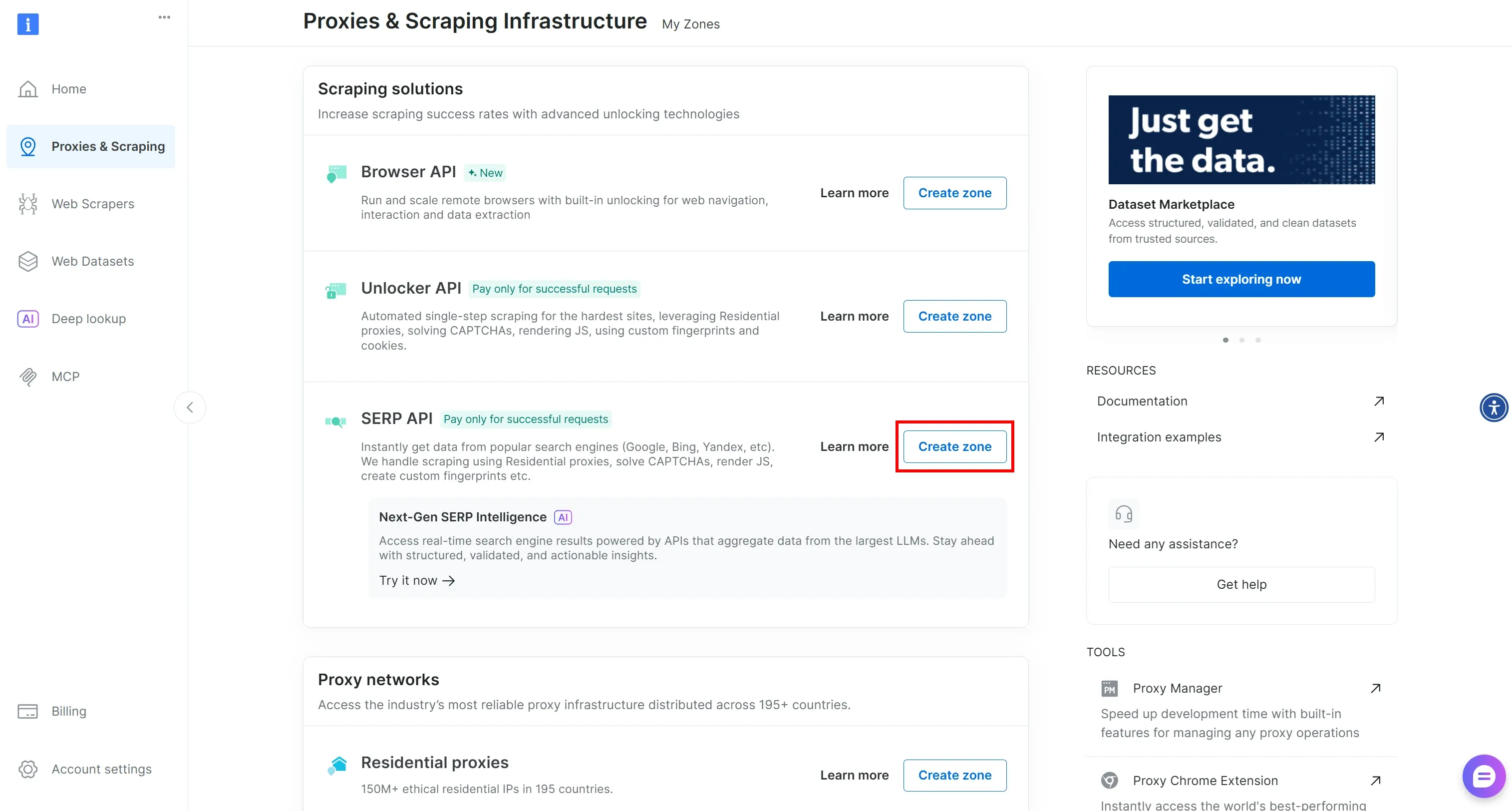
Those are separate blockers with separate solutions. If your scraper works but the output is messy, Bright Data does not help. If your scraper is being blocked, rate-limited or served different content because of where it appears to be, that is precisely what Bright Data is built for - and the proxy network is the product, with everything else layered on top.
We place Bright Data at #5 in Business & Productivity. It is infrastructure rather than an application, its pricing is among the most complex in this list, and for the specific job of collecting web data reliably at scale, few alternatives operate at the same level.
What Bright Data Actually Sells
The catalogue is broad enough that new buyers routinely misunderstand what they are choosing between. There are three distinct layers, and you can enter at any of them.
Layer one: proxy networks
The foundation. You route your own scraper’s traffic through Bright Data’s network, and requests arrive at the target from an address that looks like an ordinary user rather than a data centre.
Four network types serve different purposes:
- Residential - addresses associated with real consumer connections. The most convincing and the most expensive.
- Datacenter - fast, cheap, and the easiest for a target to identify as automated.
- ISP - addresses registered to internet service providers but hosted in data centres, sitting between the two in both cost and plausibility.
- Mobile - addresses on mobile carrier networks, for targets that treat mobile traffic differently.
At this layer you write and operate the scraper. Bright Data supplies the network and nothing else.
Layer two: managed collection tools
Products that take over progressively more of the work:
- Web Unlocker - handles blocking, challenges and retries automatically, so you request a URL and receive the content.
- Scraping Browser - a hosted browser you drive with standard automation frameworks, with the network handling underneath.
- Scraping Functions - collection logic that runs on Bright Data’s infrastructure rather than yours.
Layer three: finished data
- Web Scraper APIs - structured extraction for common target types, billed per thousand records.
- Datasets - data already collected, which you buy rather than gather.
- Bright Insights - packaged analytics products.
Choosing a layer
The decision is essentially about how much of the problem you want to own. Operating your own scraper against the raw proxy network gives maximum control and maximum maintenance. Buying a dataset gives no control and no maintenance.
Most teams underestimate the maintenance and start too low in the stack. Target sites change layout, add challenges and alter rate limits continuously; a scraper is not a project that finishes. If the data matters more to you than the pipeline, starting at layer two or three is usually the better economic decision even though the per-unit cost looks higher.
Pricing: Four Units, One Bill
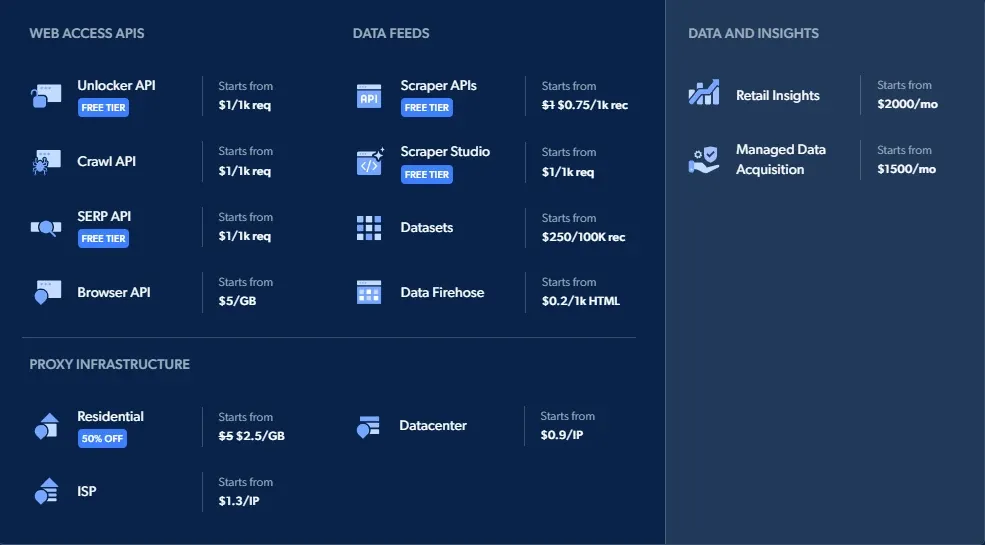
This is where Bright Data becomes hard to evaluate, and where a careful reading pays for itself. Different products bill in different units.
| Product | Billing unit | Entry rate |
|---|---|---|
| Residential proxies | Per GB | from $5, promoted at $2.50/GB |
| Datacenter proxies | Per IP | from $0.90/IP |
| ISP proxies | Per IP | from $1.30/IP |
| Browser API | Per GB | from $5/GB |
| Scraper APIs | Per 1,000 records | free tier, then from $1, promoted at $0.75/1k records |
| SERP API | Per 1,000 requests | from $1/1k requests |
Note the unit change between proxy types. Residential bills by data transferred; datacenter and ISP bill by address. That is not a detail - it means the two are not directly comparable, and a per-gigabyte instinct carried across to datacenter pricing will produce a nonsensical forecast.
The residential volume ladder
Residential proxies are the flagship, and their pricing rewards commitment steeply:
| Monthly commitment | Rate per GB | Included volume |
|---|---|---|
| No commitment | $8 promoted to $4.00/GB | Pay as you go |
| $499 | $7 promoted to $3.50/GB | around 141 GB |
| $999 | $6 promoted to $3.00/GB | around 332 GB |
| $1,999 | $5 promoted to $2.50/GB | around 798 GB |
The list rate falls from $8 to $5 per gigabyte - a 37.5 per cent reduction - between no commitment and the $1,999 tier. (Our arithmetic from the published figures.)
A promotional discount was displayed at the time of verification, roughly halving each rate. Promotional pricing changes; the underlying ladder is the structure to plan against, and you should confirm which rate applies before budgeting.
What a gigabyte of scraping actually is
Per-gigabyte pricing is meaningless without a sense of scale, so here is a rough translation. This is our own estimate and depends heavily on the target site.
A text-heavy HTML page with assets blocked might transfer 100 to 500 KB. At 250 KB average, one gigabyte is roughly 4,000 page fetches.
| Monthly volume | Approximate data | At $4.00/GB | At $2.50/GB |
|---|---|---|---|
| 40,000 pages | around 10 GB | around $40 | around $25 |
| 400,000 pages | around 100 GB | around $400 | around $250 |
| 4,000,000 pages | around 1,000 GB | around $4,000 | around $2,500 |
Two practical conclusions follow. First, blocking images and stylesheets is not an optimisation, it is the difference between a $40 bill and a $400 one - media assets dominate transfer on most sites and are almost never what you came for. Second, at the volumes where commitment tiers pay for themselves you are running a serious data operation, and the engineering discipline to minimise transfer is worth more than the tier discount.
The no-commitment option matters
Every proxy type is available without a monthly commitment, which is more important than it sounds. Web scraping projects frequently fail for reasons discovered in week two - the target changes, the data is not what you expected, the legal review says no. Starting on pay-as-you-go and moving to a commitment once the pipeline is proven is the correct sequence, and Bright Data supports it.
Bright Data Compared With Firecrawl
Because both appear in web data conversations, the distinction is worth drawing explicitly.
| Bright Data | Firecrawl | |
|---|---|---|
| Core problem | Access at scale | Output quality for language models |
| Primary product | Proxy networks | Clean markdown extraction |
| Billing | Per GB, per IP, per 1,000 records | Per credit and page |
| Handles blocking | Yes, the central capability | Yes, described as handled |
| Output format | Raw, unless you buy higher layers | Markdown, HTML, structured JSON, screenshots |
| Best for | Large-scale collection from resistant targets | RAG pipelines and agents reading the web |
The honest guidance: most teams building an AI feature want Firecrawl, because their blocker is turning pages into usable context, not getting past defences. Teams running commercial data collection at volume want Bright Data, because their blocker is being blocked.
They are also not mutually exclusive. A pipeline that uses Bright Data for access and its own or another tool for extraction is a coherent architecture, and at high volume it may be cheaper than either vendor’s full-stack offering.
Legal and Ethical Considerations
Any review of proxy and scraping infrastructure that omits this section is not doing its job, and this applies more sharply to Bright Data than to gentler tools because of what its network makes possible.
The tool is legitimate. The use determines everything. These are the considerations that belong in the decision:
- robots.txt states a site’s crawling preferences. Ignoring it is technically trivial and ethically material.
- Terms of service may prohibit automated access regardless of what robots.txt permits, and they are a contractual matter rather than a technical one.
- Copyright - collecting content is not a licence to republish it.
- Personal data - scraping pages containing personal information brings GDPR, CCPA and comparable regimes into scope, and the fact that data is publicly visible does not make it unregulated.
- Load - even where collection is permitted, saturating a small site’s capacity is antisocial and can constitute a denial of service in practice.
- Residential networks specifically deserve extra thought, because the addresses belong to real people. How a network sources its residential addresses, and whether those people consented meaningfully, is a question worth asking any provider directly.
Our position is that these obligations rest with the operator, not the vendor, and that a team deploying scraping infrastructure at scale should have a documented answer to each point above before the first request goes out - not after a legal letter arrives.
Who Should Use Bright Data, and Who Should Not
Strong fit: commercial data collection operations at meaningful volume; price and availability monitoring across many retailers; teams whose scrapers are being blocked and whose engineering time is going into evasion rather than product; organisations needing geographically specific views of a site; buyers who would rather purchase a finished dataset than build a pipeline.
Poor fit: teams whose problem is messy output rather than blocked access, where Firecrawl is the cheaper and better-fitting answer; small projects collecting from a handful of cooperative sources, where a simple HTTP client suffices; anyone unable to answer the legal questions above; teams wanting a single simple price, since this platform has one of the most complex pricing surfaces in our list.
Head-to-Head Comparisons
- Bright Data vs Firecrawl: access against output quality, as set out above. Firecrawl is the better default for AI teams; Bright Data is the better default for data operations. See the comparison table earlier in this review.
- Bright Data vs building your own proxy pool: technically possible and rarely wise. Sourcing addresses, rotating them, handling bans and maintaining geographic coverage is a full-time infrastructure job, and the cost comparison should include the engineer, not just the servers.
- Bright Data vs buying a dataset: Bright Data sells both, which makes this an internal decision rather than a vendor one. If someone already collected the data you need and the freshness is adequate, buying it is almost always cheaper than collecting it.
- Bright Data plus Zernio: adjacent infrastructure. Zernio provides API access to social platforms through official integrations rather than collection, which is the correct approach where an official API exists.
Product lines, billing units, proxy rates and the residential volume ladder in this review were verified against Bright Data’s official pricing pages on 15 August 2026, using a full browser render because the pricing is JavaScript-generated. Promotional rates displayed at that time are labelled as promotions rather than list prices. Page-count and cost-per-volume estimates are our own arithmetic and depend heavily on the target site. Confirm current terms at brightdata.com before committing to a monthly plan.
Evaluation Metrics
Accuracy in parsing call graphs, types, and catching subtle edge cases without noise.
Average execution time under 45s across PR triggers on GitHub Actions & GitLab CI.
Detection rate of OWASP Top 10 flaws, SQL injection risks, and leaked API secrets.
Time saved per senior reviewer and ease of interactive inline PR code chat.
Pros & Cons
What We Like (Pros)
- Residential, datacenter, ISP and mobile proxy networks under one account and one bill
- Volume commitments cut the residential rate from $8 to $5 per gigabyte before promotions
- Scraper APIs carry a free tier and bill per thousand records rather than per gigabyte
- No-commitment pay-as-you-go is available on every proxy type
Considerations (Cons)
- Pricing spans four billing units across several product lines, making forecasts difficult
- The lowest residential rates require commitments of $999 or more per month
- Proxy work carries legal and ethical obligations that the tool itself does not resolve
- Product breadth means most buyers pay for a catalogue far wider than they use
Bright Data vs the Closest Alternatives
Alternatives named in this review, not tools that merely share a category.
| Feature Matrix |  Bright Data Reviewed Tool |  Firecrawl |
|---|---|---|
| Rating Score | 4.8 / 5.0 | 4.7 / 5.0 |
| Pricing Model | Residential from $2.50/GB • Datacenter from $0.90/IP • Scraper APIs from $0.75/1k records | Free (1,000 credits) • Hobby $16/mo • Standard $83/mo • Scale $599/mo |
| Best For | Commercial data collection operations at meaningful volume; price and availability monitoring across many retailers. | Teams building retrieval pipelines or AI agents that read the web; anyone maintaining bespoke scrapers who would rather stop. |
| Key Differentiator | Proxy networks and scraper APIs for sites that actively block collection | Returns clean Markdown or structured JSON ready for language models, not raw HTML |
| Action / Review | Try Free | Read Review |
Frequently Asked Questions
Does Bright Data train AI models on private repository code?
No. Bright Data strictly adheres to zero-data-retention standards. Code diffs and repository context are processed in ephemeral memory for the duration of the review execution and are never stored or used to train public models.
How do I configure custom coding standards and linters?
Bright Data reads a repository configuration file placed in the root directory. You can define rule severity, exclude specific paths, set language guidelines, and prompt instructions matching your team's style guide.
Is Bright Data free for open-source software projects?
Public open-source repositories hosted on GitHub and GitLab receive free automated reviews with no cap on the number of repositories, pull requests, or contributors.
Which languages and frameworks does Bright Data support?
Bright Data covers the mainstream ecosystem - TypeScript/JavaScript, Python, Go, Java, Ruby, PHP, Rust, and C# - along with infrastructure-as-code formats such as Terraform, Dockerfiles, and Kubernetes manifests.
How does Bright Data handle security scanning?
Bright Data scans every incoming commit for hardcoded API keys, database credentials, SQL injection risks, and OWASP Top 10 security vulnerabilities before code is merged into production. High-priority security alerts are flagged directly inline within the pull request.


