

The Bottom Line
TurboStarter is ranked #2 in our Starter Kits & Boilerplates category. One monorepo shipping web, mobile and extension SaaS with auth and billing. We rate it 4.9/5.
Best for
Products that genuinely need web and mobile together rather than aspirationally; browser extensions with a backend, accounts and billing, where alternatives barely exist.
Considerations
Single web applications, where the monorepo is overhead without benefit; marketing sites and blogs, which is Shipixen's territory and where this is the wrong tool entirely.
Executive Summary & Independent Verdict
Most SaaS boilerplates give you a web application. TurboStarter gives you three: a Next.js web app, a React Native mobile app via Expo, and a browser extension built on WXT - all sharing code inside one Turborepo monorepo.
That third target is genuinely rare. Web-plus-mobile starters exist and are reasonably common; a boilerplate that also treats browser extensions as a first-class product with backend, authentication and billing attached is close to unique in this category.
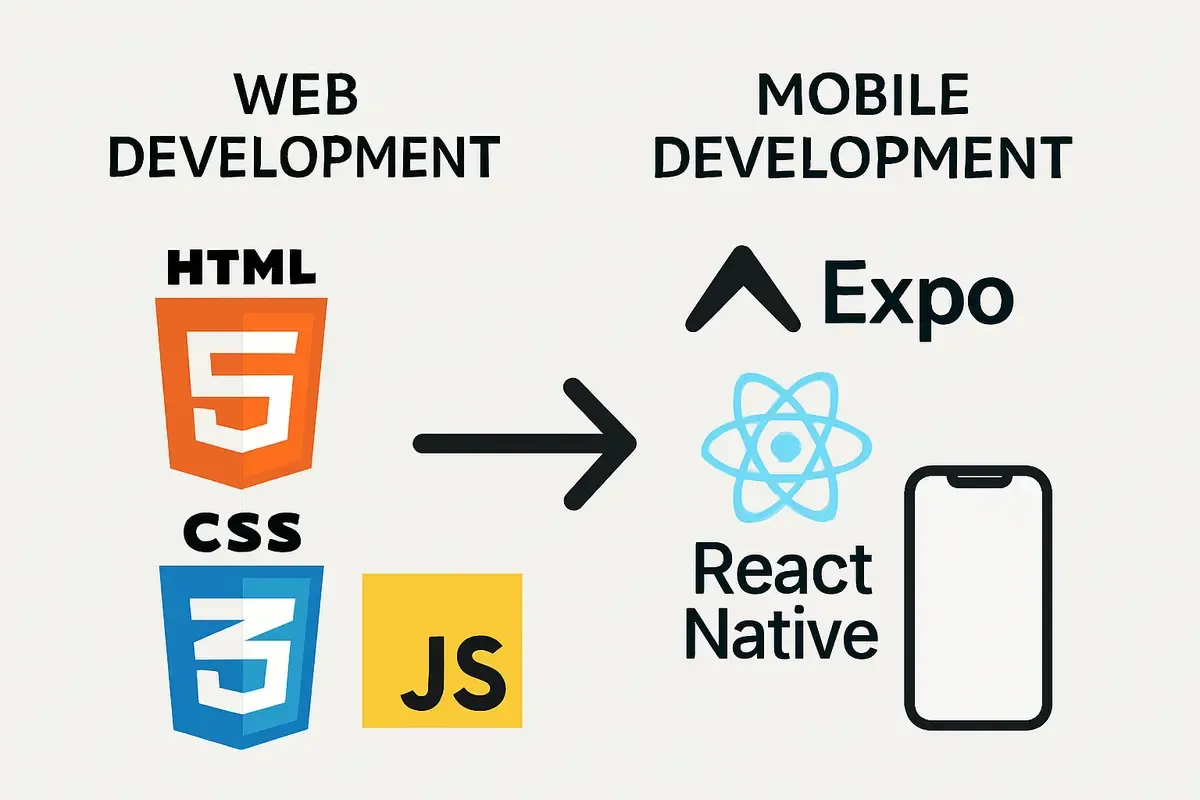
The product describes itself as an “AI-first SaaS starter & boilerplate for 2026”, which in its case means something more specific than “has AI features” - the codebase ships dedicated rules, skills and agents intended to make AI-assisted development work well against it.
We place TurboStarter at #3 in Starter Kits & Boilerplates. It has the broadest scope in this category, and it ranks below Shipixen precisely because of that breadth: more surface means more complexity, and it fits fewer people well while fitting those people very well indeed.
Three Platforms, One Monorepo

The three targets
| Platform | Technology |
|---|---|
| Web | Next.js |
| Mobile | React Native via Expo |
| Browser Extension | WXT |
Why the extension target matters
Browser extensions occupy an awkward middle ground that most tooling ignores.
They need a manifest, a specific build pipeline, background scripts and content scripts - none of which a standard web boilerplate provides. But if the extension also needs user accounts, subscriptions and a backend, you are effectively building a full SaaS product with an unusual front end, and now you need both sets of infrastructure to work together.
Most boilerplates ignore that case entirely, leaving extension developers to assemble authentication and billing themselves against a build system that was not designed for it. TurboStarter treats it as one of three equal targets, sharing authentication, billing and API layers with the web and mobile applications.
For anyone whose product is an extension, this is the single strongest reason to look here, and it is worth more than any individual feature in the stack.
The monorepo trade-off, stated fairly
Turborepo keeps the three targets in one repository with shared packages. When it fits, this is genuinely excellent: define a type once and share it across web, mobile and extension; change an API contract and see every consumer update; share validation logic rather than maintaining three copies that drift.
When it does not fit, it is pure overhead. If you only ever ship a web application, you inherit a monorepo’s build configuration, workspace management, dependency hoisting behaviour and mental model in exchange for nothing at all.
There is no version of TurboStarter that is “just the web part” - the architecture is the product, and stripping it back would take longer than starting from a simpler base.
Be honest about which situation you are in before buying. This is the decision that determines whether the $249 was well spent, and no amount of feature quality compensates for buying the wrong shape of tool.
What “AI-First” Actually Means
Vendors use “AI-first” loosely, so it is worth separating what is verifiable from what is marketing.
What is stated: the codebase ships dedicated rules, skills and agents for AI-assisted development.
Why that could matter in 2026: coding agents work dramatically better against codebases with clear structural conventions and explicit instructions. A repository that tells an agent where things live, what patterns to follow, which commands to run and what not to touch produces substantially better output than one the agent must infer from scratch.
As agent-assisted development becomes the default rather than the exception, a boilerplate designed for it has a real and compounding advantage. The first week of a project is when an agent has the least context, and a codebase that supplies that context front-loads the benefit.
What we cannot verify: how substantial those rules, skills and agents actually are. There is a wide gap between a thoughtfully maintained set of conventions with well-scoped agent definitions, and a couple of configuration files added to satisfy a marketing claim.
The practical guidance: ask to see them before purchase, or check what is published. Unlike most marketing claims, this one is concretely checkable - request the file list. If it is thin, the boilerplate may still be worth buying on its other merits, but not for this one, and you should discount the “AI-first” framing accordingly.
SaaS Foundations Included
The stack underneath is current and coherent: Turborepo, React, Next.js, Expo, Vite, Hono, TanStack, Better Auth, Cloudflare, Tailwind CSS, Stripe, PostgreSQL, Supabase and Drizzle ORM.
What that assembles into:
Authentication via Better Auth, configured rather than left as an exercise.
Billing via Stripe. This is the piece that consumes the most time to implement correctly, and the difficulty is not the initial charge - it is subscription lifecycle handling. Upgrades, downgrades, proration, failed payments, dunning, cancellation at period end, webhooks arriving out of order. Every one of those is a well-known problem with a well-known solution that still takes days to implement and test.
Organizations and teams, meaning multi-tenancy from the start. Retrofitting team accounts onto a single-user data model is one of the most painful refactors in SaaS development - every query gains a tenant filter, every permission check gains a scope, and the migration has to preserve existing data. Starting with it already modelled avoids that entirely, and it is arguably worth the purchase price on its own.
Data layer - PostgreSQL with Drizzle ORM, and Supabase in the stack. If you want context on that backend, see our Supabase review.
API layer - Hono running on Cloudflare.
Internationalization, admin panels and CLI tools round it out, along with more than 25 pre-built SaaS project ideas for anyone who has the capability and not the concept.
The learning curve is real
Turborepo, Hono, Drizzle, Expo and WXT together represent a lot of surface area if you have not used them. Each is a reasonable choice individually; collectively they are a genuine ramp-up.
If your team already works this way, the boilerplate saves weeks. If it does not, some of that saving is spent learning the stack instead - which is fine, and often a good investment, but should be planned for rather than discovered in week two when the deadline has not moved.
Pricing and Licence
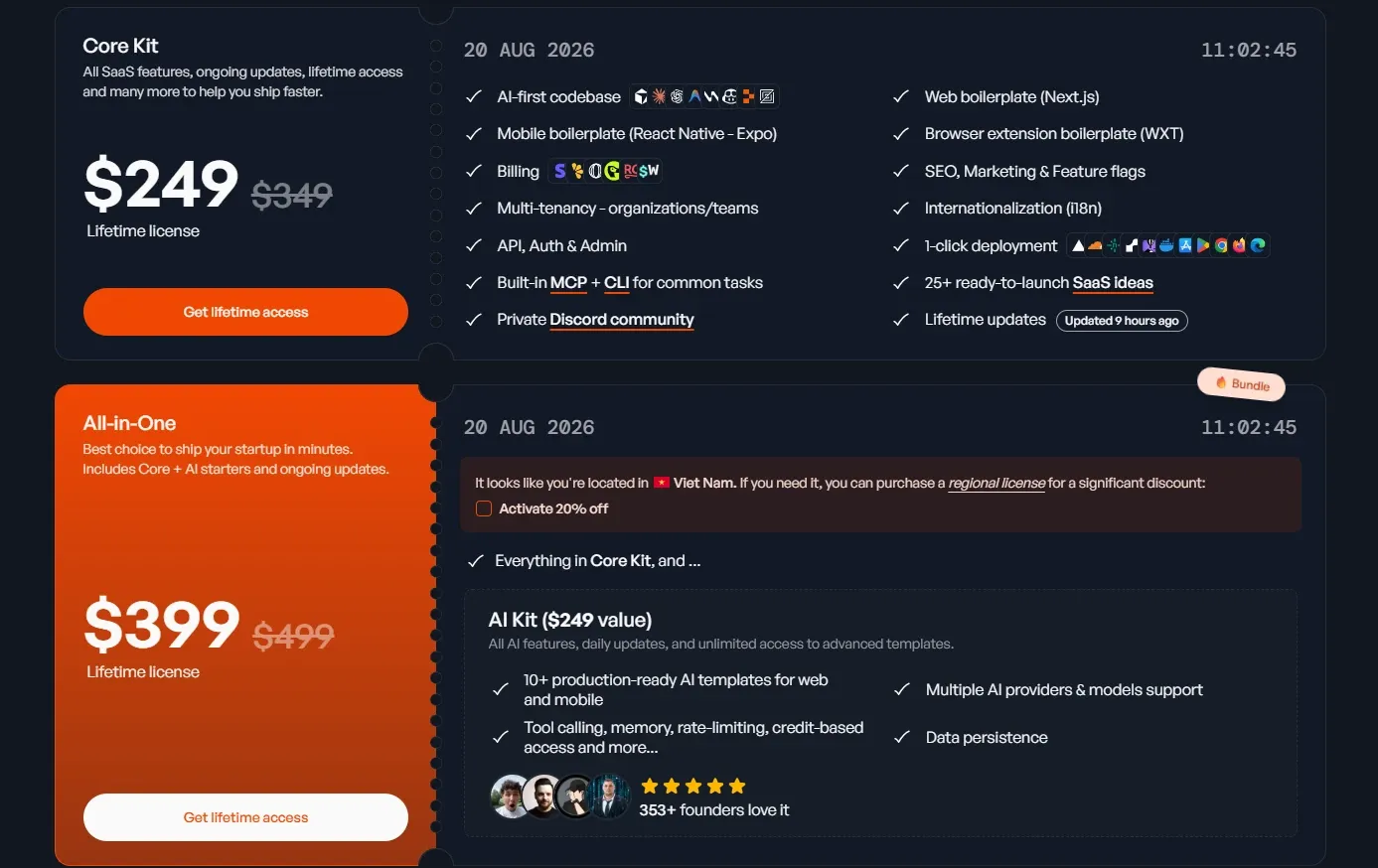
| Tier | Price | Contents |
|---|---|---|
| Core Kit | $249, from $349 | “Lifetime license”, “AI-first codebase”, all SaaS features, ongoing updates, lifetime access |
| Bundle, All-in-One | $399, from $499 | “Lifetime license” - Core Kit plus AI Kit, listed at $249, with “10+ production-ready AI templates for web and mobile” |
Both are one-time purchases including lifetime updates and covering unlimited projects.
The licence terms are notably generous
This deserves a direct comparison, because it is where TurboStarter clearly beats its closest neighbour.
Shipixen restricts each licence to one device and sells a one-year option alongside the lifetime one. TurboStarter is lifetime, unlimited projects, with no device restriction stated.
For a developer working across a desktop and a laptop, or an agency using it on several products, that difference is material and favours TurboStarter clearly. It also removes a category of friction that produces support tickets rather than value.
Core against Bundle
The Bundle costs $150 more and includes an AI Kit listed at $249.
Taken at face value that is a strong deal. Taken sceptically, a component priced at $249 and bundled for an incremental $150 is a familiar pricing pattern, and the standalone price is best treated as a reference point rather than an observed market rate.
Verify whether the AI Kit is genuinely sold separately at $249 if that number is influencing your decision.
The substantive question is simpler and does not depend on the pricing: do you want more than 10 production-ready AI templates for web and mobile? If your product has an AI feature, $150 is likely less than building the equivalent yourself. If it does not, Core Kit is the right purchase and the Bundle is money spent on templates you will delete.
A note on the permanent discount
Both tiers display a struck-through higher price of $349 and $499. Whether those prices are ever charged is unclear, and permanently displayed discounts are common in this category.
Judge the product at $249 and $399, which are the prices that appear to actually apply, and do not treat the saving as part of the value.
Who Should Use TurboStarter, and Who Should Not
Strong fit: products that genuinely need web and mobile together rather than aspirationally; browser extensions with a backend, accounts and billing, where alternatives barely exist; teams already comfortable with monorepos and the tooling around them; developers who want a codebase designed for AI-assisted work; anyone building several products, given the unlimited-project lifetime licence.
Poor fit: single web applications, where the monorepo is overhead without benefit; marketing sites and blogs, which is Shipixen’s territory and where this is the wrong tool entirely; developers unfamiliar with Turborepo, Hono and Drizzle who need to ship next week; anyone who wants the smallest possible codebase to hold in their head.
Head-to-Head Comparisons
- TurboStarter vs Shipixen: the defining comparison in this category, between two products that are not substitutes despite similar prices. Shipixen generates unlimited marketing sites and blogs, licensed per device. TurboStarter delivers one multi-platform SaaS foundation with authentication and billing, licensed for unlimited projects and devices. Decide what you are building first; comparing the prices before that is meaningless.
- TurboStarter vs building it yourself: authentication, Stripe subscription handling, multi-tenancy and an extension build pipeline represent weeks of work before your product has a single distinctive feature. $249 against that is straightforward arithmetic - provided you would genuinely have built all of it, which is the assumption worth testing honestly.
- TurboStarter vs Lovable and v0: different approaches to speed. Lovable and v0 generate an application from a prompt, quickly, with the architecture chosen for you. TurboStarter hands you a professionally structured foundation to build on deliberately. Generated speed against architectural control, and the right answer depends on whether the result needs to survive three years of development.
Product positioning, target platforms, technology stack, feature list and pricing in this review were verified against TurboStarter’s official site on 21 August 2026. The scope of its “AI-first” rules, skills and agents, and whether the AI Kit is genuinely sold standalone at $249, could not be independently confirmed and are flagged as requiring verification. Confirm current terms at turbostarter.dev before purchasing.
Evaluation Metrics
Accuracy in parsing call graphs, types, and catching subtle edge cases without noise.
Average execution time under 45s across PR triggers on GitHub Actions & GitLab CI.
Detection rate of OWASP Top 10 flaws, SQL injection risks, and leaked API secrets.
Time saved per senior reviewer and ease of interactive inline PR code chat.
Pros & Cons
What We Like (Pros)
- Ships web, mobile and browser-extension targets from a single Turborepo monorepo
- Lifetime licence covering unlimited projects with ongoing updates
- Authentication, Stripe billing, organizations and internationalization are wired up from the start
- Codebase ships dedicated rules, skills and agents for AI-assisted development
Considerations (Cons)
- Monorepo complexity is overhead if you only need a web app
- Turborepo, Hono and Drizzle together make for a steep learning curve
- The AI Kit is only bundled at the $399 tier
- Headline prices are permanently shown as discounted from a higher list price
TurboStarter vs the Closest Alternatives
Alternatives named in this review, not tools that merely share a category.
| Feature Matrix |  TurboStarter Reviewed Tool |  Shipixen |
|---|---|---|
| Rating Score | 4.9 / 5.0 | 4.9 / 5.0 |
| Pricing Model | Core Kit $249 • Bundle $399 (lifetime, unlimited projects) | 1-Year $249 • Lifetime $379 (unlimited generations) |
| Best For | Products that genuinely need web and mobile together rather than aspirationally; browser extensions with a backend, accounts and billing, where alternatives barely exist. | Agencies building sites for many clients, where the per-project cost collapses; indie developers launching several products a year. |
| Key Differentiator | One Turborepo monorepo targeting web, mobile and browser extension | Generates a configured Next.js repository rather than shipping a template |
| Action / Review | Try Free | Read Review |
Frequently Asked Questions
Does TurboStarter train AI models on private repository code?
No. TurboStarter strictly adheres to zero-data-retention standards. Code diffs and repository context are processed in ephemeral memory for the duration of the review execution and are never stored or used to train public models.
How do I configure custom coding standards and linters?
TurboStarter reads a repository configuration file placed in the root directory. You can define rule severity, exclude specific paths, set language guidelines, and prompt instructions matching your team's style guide.
Is TurboStarter free for open-source software projects?
Public open-source repositories hosted on GitHub and GitLab receive free automated reviews with no cap on the number of repositories, pull requests, or contributors.
Which languages and frameworks does TurboStarter support?
TurboStarter covers the mainstream ecosystem - TypeScript/JavaScript, Python, Go, Java, Ruby, PHP, Rust, and C# - along with infrastructure-as-code formats such as Terraform, Dockerfiles, and Kubernetes manifests.
How does TurboStarter handle security scanning?
TurboStarter scans every incoming commit for hardcoded API keys, database credentials, SQL injection risks, and OWASP Top 10 security vulnerabilities before code is merged into production. High-priority security alerts are flagged directly inline within the pull request.


