

The Bottom Line
Devs.ai is ranked #8 in our AI Coding & Development category. Governed enterprise AI platform for building, distributing and controlling internal agents. We rate it 4.7/5.
Best for
Organisations with AI usage scattered across departments and no central policy; companies that need contractual assurance their data is not used for model training.
Considerations
Individual developers wanting to generate code, which is the wrong category entirely and where v0 or Lovable are the right tools; small teams with no governance requirement, who will pay for controls they do not need.
Executive Summary & Independent Verdict
Devs.ai, an AppDirect company, is widely mislabelled as an AI app builder in the mould of Lovable or v0. Reading it that way leads to the wrong evaluation entirely, and to disappointment on both sides - developers find it does not do what they wanted, and the people it was built for never find it.
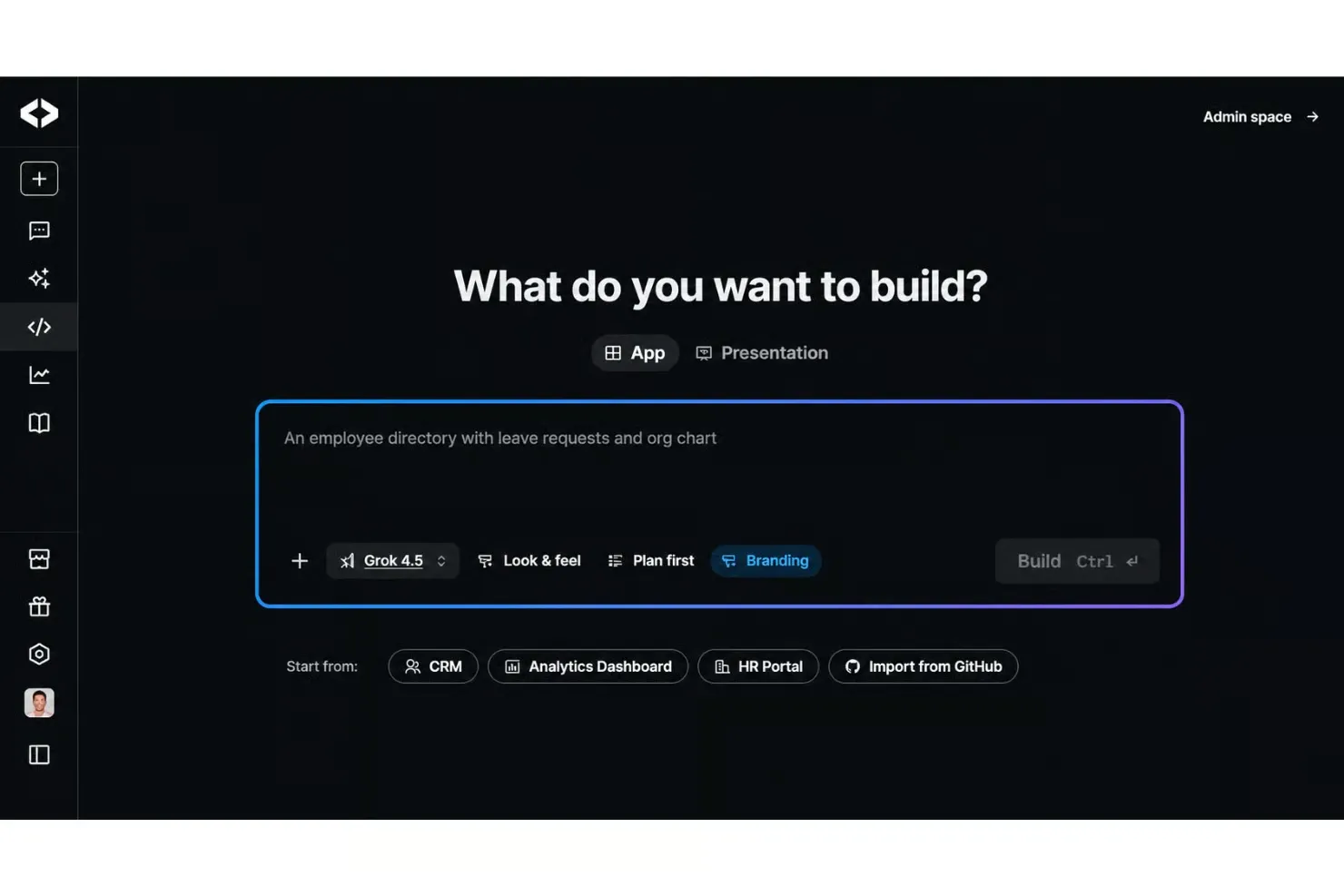
It is an enterprise AI platform: build with App Builder and Agent Builder, distribute internally through a Private AI Store, search connected systems with Enterprise Search, and control spend through an AI Cost Center. The output is not a deployable web application for customers. It is a governed environment in which a company’s internal AI usage happens.
Its real competitor is not another builder. It is ungoverned AI sprawl - the situation where finance discovers eleven separate AI subscriptions across five departments, nobody can say which of them contain company data, and no one is certain what any of them do with the prompts.
We place Devs.ai at #8 in AI Coding & Development. That ranking is about audience fit rather than quality: it solves a problem most individual developers do not have, and it solves it more completely than tools that do.
The Real Problem It Solves: Ungoverned AI Sprawl
The pattern is familiar in most organisations of any size. Marketing buys one assistant. Support buys another. An engineer expenses a third. Legal quietly uses a fourth for contract summarisation.
Each purchase is individually reasonable, and collectively they produce three problems that no individual buyer is positioned to solve:
- Nobody knows what data has left the building. Prompts contain customer records, contract terms, unreleased plans and internal financials. There is no log, no policy and no way to audit after the fact.
- Nobody knows the total cost. Spend is scattered across expense reports, departmental cards and annual renewals nobody centrally tracks.
- Nobody can enforce a policy, because there is no single place where a policy could be applied.
Devs.ai’s answer is to make that single place exist. And the most consequential line on its pricing page addresses the first problem directly: Zero-Training Agreements with LLM Providers, applying across all plans.
Why that line matters more than it looks
Compare it with how the rest of the market handles the same concern. In our v0 review we noted that default training opt-out begins at the $100 per user per month Business tier. Across this category, contractual assurance about model training is typically an enterprise-tier feature or a negotiated term.
Devs.ai includes zero-training agreements on the free plan.
For a chief information security officer, that is not a feature comparison - it is a different starting position. The usual conversation is “can we get an assurance, at what tier, and what will it cost?” Here the assurance is the default, and the tiers are about capability rather than about whether your data is safe.
Platform Components
App Builder
Describe a business application in natural language and get a working application: dashboards, CRMs, onboarding portals, process trackers, internal approval tools and knowledge applications.
Note the shape of that list carefully, because it defines the product. These are the internal tools that normally either wait years in an IT backlog or get built in a spreadsheet by someone in operations who then becomes permanently responsible for maintaining it.
That is the gap App Builder targets. Not customer-facing product, but the long tail of internal software that every organisation needs and no engineering team has capacity to build.
Agent Builder
Purpose-built agents for specific business processes. Available in a Core version on Free and Full from Personal upward.
Enterprise Search
This is the technically most interesting component and the one worth evaluating most carefully. Search delivers permission-aware, context-aware results across connected business systems - Google Drive, Confluence, Slack, Jira and beyond.
Permission-aware is the operative phrase and the genuinely hard part.
A naive search index over company systems is a data breach with a search box. It will happily return the HR folder, the acquisition documents and the salary spreadsheet to anyone who asks, because indexing flattens the access controls that made those documents safe to store.
Respecting each source system’s existing access controls at query time - so that results differ correctly depending on who is searching, and continue to differ correctly when permissions change in the source system - is what makes such a tool deployable at all rather than a liability.
If you evaluate one component in a trial, make it this one, and test it as a low-privilege user rather than as an administrator. An administrator sees everything and learns nothing about whether the permission model works.
Private AI Store
Internal distribution. Someone builds a useful agent; the Store is how the rest of the organisation finds and uses it, instead of it living in one person’s browser tab and disappearing when they change roles.
This addresses a real and under-discussed failure mode. Most organisations already contain several genuinely useful AI workflows built by individuals, none of which anyone else knows about. Distribution turns individual productivity into organisational capability.
AI Cost Center
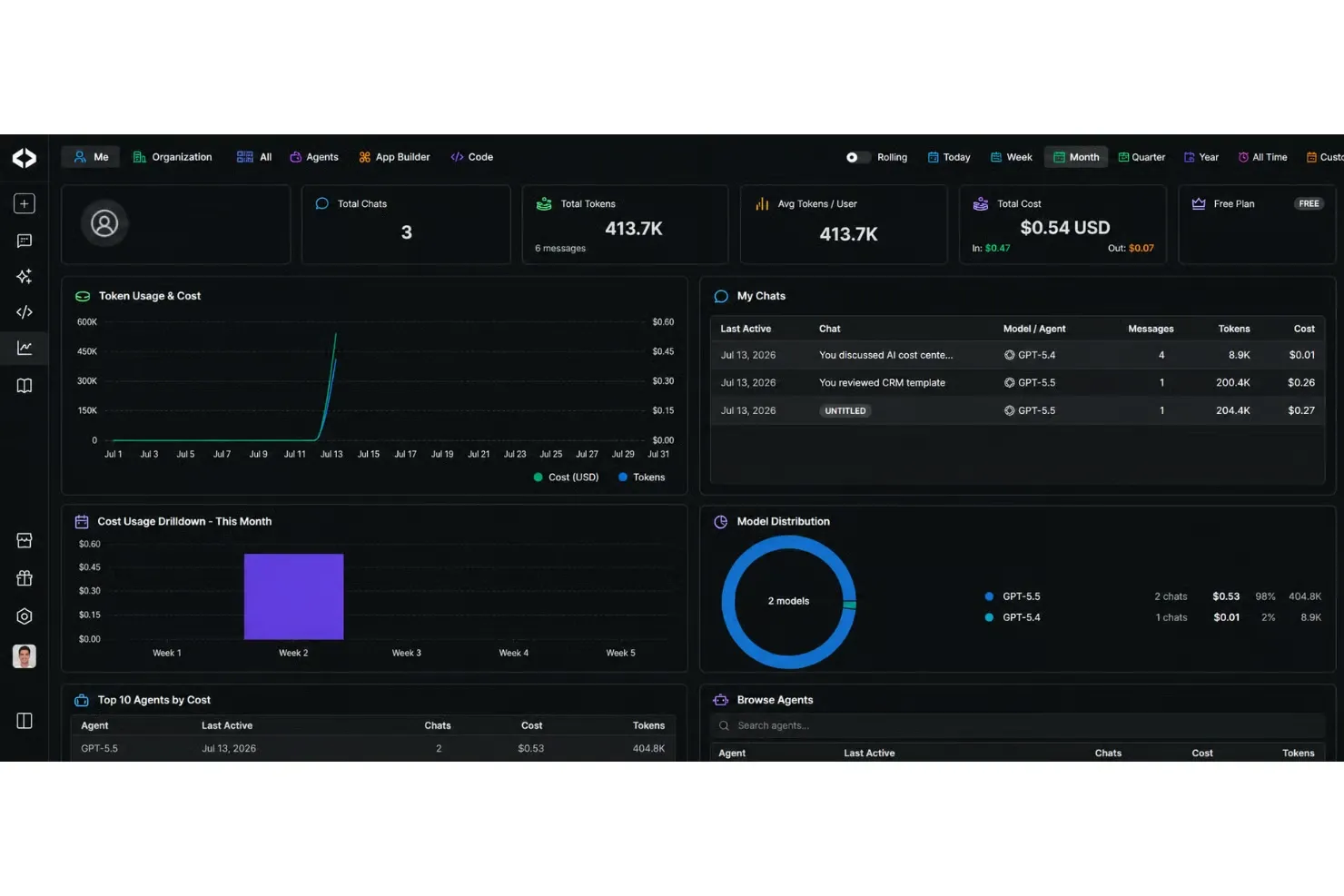
Centralised spend control. This pairs directly with the included-usage model in the pricing below, and it is the component that gets finance to sign - because it converts an unmanageable set of departmental expenses into a single line with attribution behind it.
Collaboration
A real-time collaboration workspace lets several people work together on agents and applications - reviewing prompts, refining logic, testing outputs and iterating side by side rather than passing exports around.
Note: the component descriptions in this section are compiled from Devs.ai’s own site and third-party coverage. We recommend confirming specific capabilities against current product documentation before making a purchasing decision on any single one.
Governance, Security and Compliance
This is where the product earns its position, and where the pricing structure holds its one significant trap.
Compliance on every plan
SOC 2 Type II, GDPR and CCPA apply across all plans, together with more than 100 connectors, growing weekly and the Zero-Training Agreements noted above.
Compliance coverage on a free tier is rare. It usually sits behind an enterprise contract precisely because it is expensive to maintain and useful as a sales lever. Including it from the free plan is a deliberate signal about who the product is for - and about the fact that Devs.ai expects to be evaluated by security teams rather than by individual users.
Where governance actually begins
Here is the trap, and it is worth being blunt about:
| Capability | Free | Personal | Business | Enterprise |
|---|---|---|---|---|
| Best of every AI model | Included | Included | Included | Included |
| Agent Builder | Core | Full | Full | Full |
| App Builder | Core | Full | Full | Full |
| Workflows, APIs, integrations | Not included | Included | Included | Included |
| Team governance and collaboration | Not included | Not included | Included | Included |
| SSO, ACLs, multi-tenancy | Not included | Not included | Not included | Included |
| Data upload | 2 GB | 10 GB | 20 GB | Custom |
Team governance and collaboration begin at Business. Single sign-on, access control lists and multi-tenancy are Enterprise-only.
That second row deserves emphasis. This is a platform whose central argument is governance - and single sign-on, the most basic access-control primitive any enterprise requires, is not available until the custom-priced tier.
An organisation buying Devs.ai because of its governance story will very likely find itself in an Enterprise negotiation rather than on the $30 seat price it evaluated. That is not necessarily wrong - enterprise governance is an enterprise purchase - but it is considerably better to know at the start than at renewal, and the published pricing does not make it obvious.
Pricing and What “Included Usage” Actually Means
| Plan | Price | Included usage | Data upload |
|---|---|---|---|
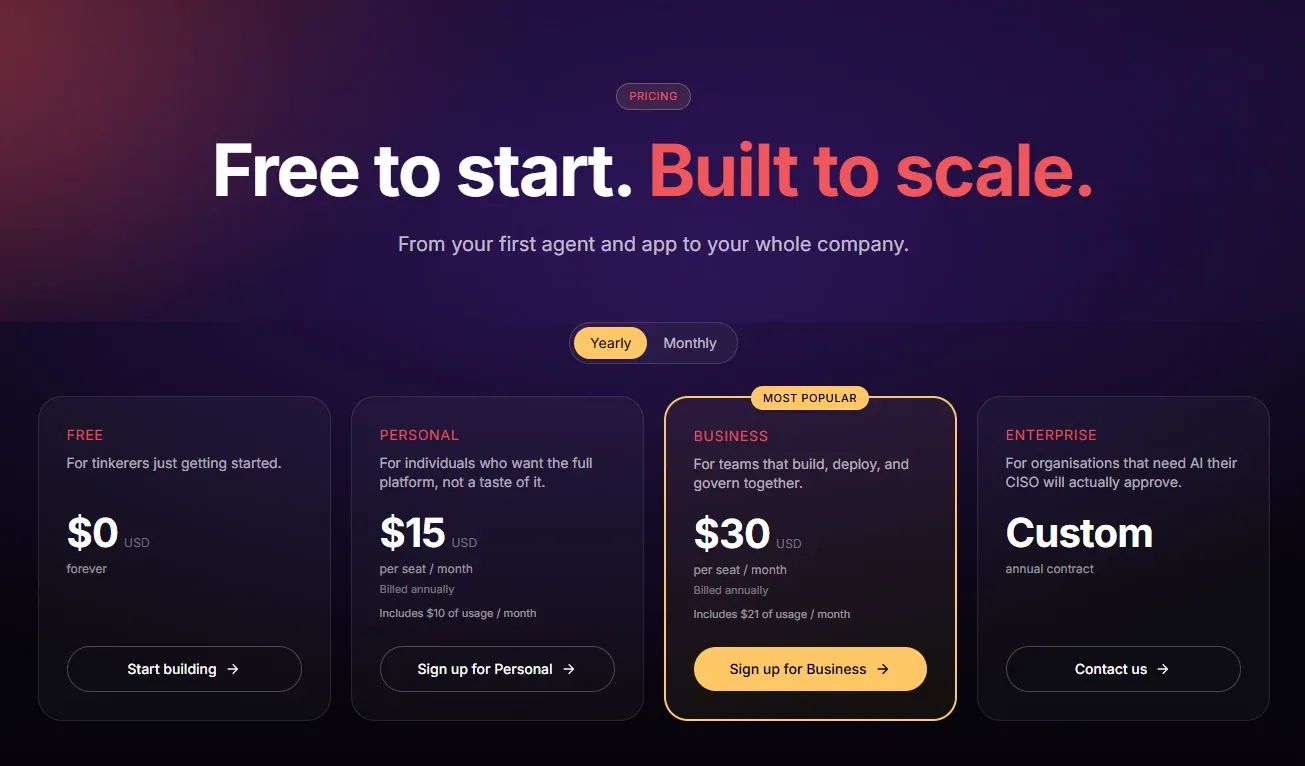
| Free | $0 forever | None | 2 GB |
| Personal | $15/seat/month, billed annually | $10 usage/month | 10 GB |
| Business | $30/seat/month, billed annually | $21 usage/month | 20 GB |
| Enterprise | Custom, annual contract | Custom | Custom |
Devs.ai describes the tiers in its own words: Free “For tinkerers just getting started”; Personal “For individuals who want the full platform, not a taste of it”; Business “For teams that build, deploy, and govern together”; Enterprise “For organisations that need AI their CISO will actually approve.”
The hybrid seat-plus-usage model
Read the usage allowances carefully. Personal is $15 per seat and includes $10 of usage. Business is $30 per seat and includes $21.
In both cases the included usage is less than the seat price. This is not a criticism - it is a normal structure for platforms that resell model inference - but it means your real cost is seat price plus whatever usage exceeds the allowance.
Our own arithmetic for a twenty-person Business deployment: $600 per month in seats, plus $420 of included usage, plus any consumption beyond that. A team using AI heavily could easily double the bill, and a team using it lightly leaves included usage unspent.
Budget for the seats, then model the usage separately. Treating $30 as the all-in number will understate the bill, and treating it as a ceiling will misprice the deployment entirely.
Everything is billed annually
The published seat prices assume annual billing. There is no headline monthly option, which means committing for a year to obtain the listed rate - worth factoring into a pilot, since the natural way to trial a platform is monthly and that path is not offered at these prices.
The data ceiling is a real constraint
2 GB free, 10 GB Personal, 20 GB Business.
For most agent-building work that is ample. For Enterprise Search over a substantial document corpus, it is the number to check first. Twenty gigabytes does not go far against years of accumulated Confluence pages, Drive documents and shared files - a mid-sized company’s knowledge base will exceed it comfortably.
If Enterprise Search is the reason you are buying, this constraint may push you to Enterprise on capacity grounds alone, independent of the governance features. That is worth establishing during evaluation by measuring your actual corpus rather than estimating it.
How to Evaluate Devs.ai
Because this is a governance purchase rather than a productivity purchase, the evaluation looks different from a normal software trial. Four steps:
- Inventory current AI spend and tools across departments. The number is usually larger than expected, and it is the baseline against which Devs.ai is measured.
- Test Enterprise Search as a low-privilege user. This is the technically hardest capability and the one most likely to disappoint.
- Establish which tier your requirements actually land on. If single sign-on is mandatory, you are pricing Enterprise, not Business.
- Measure your document corpus against the data ceiling before assuming a tier fits.
Who Should Use Devs.ai, and Who Should Not
Strong fit: organisations with AI usage scattered across departments and no central policy; companies that need contractual assurance their data is not used for model training; teams needing permission-aware search across Drive, Confluence, Slack and Jira; finance functions that need a single answer to what the organisation spent on AI this month; businesses with a backlog of internal tools nobody has capacity to build.
Poor fit: individual developers wanting to generate code, which is the wrong category entirely and where v0 or Lovable are the right tools; small teams with no governance requirement, who will pay for controls they do not need; organisations that need single sign-on but cannot reach an Enterprise agreement; anyone whose corpus exceeds the data ceilings on the published tiers.
Head-to-Head Comparisons
- Devs.ai vs CodeRabbit: different layers of the same organisation. CodeRabbit reviews engineering output; Devs.ai governs how the whole company uses AI. They do not overlap and can sensibly coexist.
- Devs.ai vs Lovable and v0: frequently confused, rarely comparable. Lovable and v0 generate applications for developers to ship to customers. Devs.ai builds internal tools and governs AI usage across an organisation. Different buyers, different budgets, different definitions of success.
- Devs.ai vs assembling it yourself: the realistic alternative for many organisations is a single-sign-on-protected chat interface plus a spreadsheet of subscriptions. That works until someone asks what data has left the company, at which point it does not.
Pricing tiers, included usage, data allowances, the per-tier feature matrix and compliance claims in this review were verified against Devs.ai’s official pricing page on 20 August 2026 - a JavaScript-rendered page that required a full browser render to read. The twenty-seat cost model is our own arithmetic. Component descriptions draw partly on third-party coverage and are flagged as such. Confirm current terms at devs.ai before purchasing, particularly regarding single sign-on availability.
Evaluation Metrics
Accuracy in parsing call graphs, types, and catching subtle edge cases without noise.
Average execution time under 45s across PR triggers on GitHub Actions & GitLab CI.
Detection rate of OWASP Top 10 flaws, SQL injection risks, and leaked API secrets.
Time saved per senior reviewer and ease of interactive inline PR code chat.
Pros & Cons
What We Like (Pros)
- SOC 2 Type II, GDPR and CCPA coverage on every plan including the free tier
- Zero-Training Agreements with LLM providers apply across the platform
- Enterprise Search returns permission-aware results across connected business systems
- The AI Cost Center gives finance a single view of organisation-wide AI spend
Considerations (Cons)
- SSO, ACLs and multi-tenancy are restricted to the Enterprise tier
- Team governance and collaboration only start at the Business plan
- Listed seat prices are billed annually, with no headline monthly option
- Data upload is capped at 2 GB free, 10 GB Personal and 20 GB Business
Devs.ai vs the Closest Alternatives
Alternatives named in this review, not tools that merely share a category.
| Feature Matrix |  Devs.ai Reviewed Tool | Building it in-house Not reviewed here |
|---|---|---|
| Rating Score | 4.7 / 5.0 | Not rated by us |
| Pricing Model | Free • Personal $15/seat/mo • Business $30/seat/mo (billed annually) | Engineering time, not a licence fee |
| Best For | Organisations with AI usage scattered across departments and no central policy; companies that need contractual assurance their data is not used for model training. | Organisations with no governance or data-residency requirement |
| Key Differentiator | Central governance for company-wide AI use, with contractual zero-training | An SSO-protected chat interface plus a spreadsheet of subscriptions |
| Action / Review | Try Free |
Frequently Asked Questions
Does Devs.ai train AI models on private repository code?
No. Devs.ai strictly adheres to zero-data-retention standards. Code diffs and repository context are processed in ephemeral memory for the duration of the review execution and are never stored or used to train public models.
How do I configure custom coding standards and linters?
Devs.ai reads a repository configuration file placed in the root directory. You can define rule severity, exclude specific paths, set language guidelines, and prompt instructions matching your team's style guide.
Is Devs.ai free for open-source software projects?
Public open-source repositories hosted on GitHub and GitLab receive free automated reviews with no cap on the number of repositories, pull requests, or contributors.
Which languages and frameworks does Devs.ai support?
Devs.ai covers the mainstream ecosystem - TypeScript/JavaScript, Python, Go, Java, Ruby, PHP, Rust, and C# - along with infrastructure-as-code formats such as Terraform, Dockerfiles, and Kubernetes manifests.
How does Devs.ai handle security scanning?
Devs.ai scans every incoming commit for hardcoded API keys, database credentials, SQL injection risks, and OWASP Top 10 security vulnerabilities before code is merged into production. High-priority security alerts are flagged directly inline within the pull request.


